The IVF Process Explained: A Complete Step-by-Step Guide for South Africans
If you have been told that IVF might be your path to parenthood, you probably have a hundred questions. What actually happens? How long does it take? Will it hurt? What are your chances?
The good news is that IVF — in vitro fertilisation — is one of the most well-understood and successful fertility treatments available today. Millions of babies worldwide have been born through IVF, and in South Africa, accredited fertility clinics achieve pregnancy rates comparable to the best international centres.
This guide walks you through every stage of the IVF process in plain, honest language — from your very first consultation to the moment you take a pregnancy test.
Related reading: For a full overview of IVF in South Africa including clinic comparisons, see our guide: IVF in South Africa — The Complete Guide. For cost planning, see our IVF Cost Breakdown 2025.
What Is IVF?
IVF stands for in vitro fertilisation — literally, ‘fertilisation in glass’. It is a type of assisted reproductive technology (ART) in which eggs are retrieved from the ovaries, fertilised with sperm in a laboratory, and the resulting embryo is transferred back into the uterus.
IVF is recommended for people with a wide range of fertility challenges, including:
- Blocked or damaged fallopian tubes
- Severe endometriosis
- Low ovarian reserve or poor egg quality
- Male factor infertility — see our full guide: Male Infertility: Causes, Tests & Treatments
- Unexplained infertility after other treatments have not worked
- Recurrent miscarriages where genetic testing of embryos is needed
- Same-sex couples and single parents using donor eggs or sperm
How Long Does IVF Take?
A single IVF cycle takes approximately four to six weeks from the start of medication to the pregnancy test. Here is a typical timeline:
- Weeks 1–2: Initial consultations, baseline investigations, and treatment planning
- Weeks 2–3: Ovarian stimulation with daily hormone injections
- End of Week 3: Egg collection procedure
- Lab: Fertilisation and embryo development over 3–5 days
- Embryo transfer: Day 3 or Day 5 (blastocyst stage)
- Two weeks after transfer: Pregnancy blood test
The IVF Process: Step by Step
Step 1 — Initial Consultation and Fertility Assessment
Before IVF begins, your fertility specialist will conduct a thorough assessment including transvaginal ultrasound, ovarian reserve tests (AMH and Day 3 FSH), semen analysis, and a full medical history review.
South Africa’s SASREG-accredited clinics conduct this assessment to international standards. Find a specialist near you:
- Western Cape: Cape Fertility (Cape Town) | Aevitas Fertility Clinic
- Gauteng: Genesis Reproductive Centre (Pretoria)
- KwaZulu-Natal: Durban Fertility Clinic | C.A.R.E Clinic (Westville)
- Eastern Cape: Fembryo Fertility Clinic (Port Elizabeth)
- Garden Route: George Fertility Clinic
South African context: Diagnostic investigations are often partially covered under Prescribed Minimum Benefits (PMBs). See our guide to Medical Aid Coverage for Fertility Treatment before your first appointment.
Step 2 — Ovarian Stimulation
You will self-administer hormone injections (gonadotrophins) for approximately 10 to 14 days to stimulate the ovaries to produce multiple eggs. Regular clinic monitoring via ultrasound and blood tests tracks your response.
Side effects: Bloating, mood changes, and mild discomfort are common. Report severe pain, rapid weight gain, or breathlessness to your clinic immediately — these can be signs of OHSS.
Step 3 — Trigger Injection
When follicles reach the right size (18–20mm), a ‘trigger injection’ (hCG or GnRH agonist) finalises egg maturation. Egg collection is scheduled exactly 34–36 hours later.
Step 4 — Egg Collection
Performed under sedation. A needle guided by ultrasound retrieves fluid from follicles; the embryologist identifies any mature eggs. Takes approximately 20–30 minutes. A semen sample is produced on the same day.
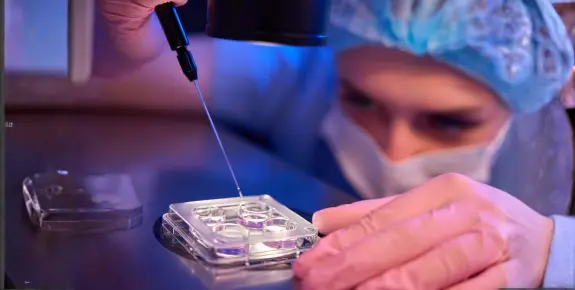
Step 5 — Fertilisation
Eggs are fertilised using conventional IVF (eggs and prepared sperm together in a dish) or ICSI (a single sperm injected directly into each egg). If your specialist has recommended ICSI, read our dedicated guide: What Is ICSI? Intracytoplasmic Sperm Injection Explained.
Step 6 — Embryo Development
Embryos are monitored as they divide over 3–5 days. Most clinics culture to Day 5 blastocyst stage for higher implantation rates. Where genetic testing is recommended, Next Biosciences (nextbio.co.za) provides PGT-A embryo screening.
Step 7 — Embryo Transfer
A thin catheter deposits the embryo in the uterus under ultrasound guidance. No sedation is needed. Elective single embryo transfer (eSET) is recommended in most cases. Surplus embryos can be frozen for future cycles.
Step 8 — The Two-Week Wait
Two weeks between transfer and pregnancy test. Normal activities are fine. Symptoms — or their absence — are not reliable predictors of outcome. Support resources are listed on the Fertility Solutions support page.
Step 9 — Pregnancy Test
A blood test (beta-hCG) confirms pregnancy approximately 10–14 days post-transfer. A positive result leads to a scan two weeks later to confirm heartbeat and location.
IVF Success Rates
- Under 35: approximately 40–50% live birth rate per cycle
- 35–37: approximately 30–40% per cycle
- 38–40: approximately 20–30% per cycle
- Over 40 (own eggs): approximately 10–20% per cycle; significantly higher with donor eggs
For more on success rates and what to expect across multiple cycles, see our guide: IVF in South Africa — The Complete Guide.
Myths vs Facts About IVF
Myth: IVF always results in twins or triplets
Fact: Modern practice favours single embryo transfer. Multiple pregnancy is a complication to avoid, not a goal.
Myth: IVF babies have more health problems
Fact: Large-scale research consistently shows IVF babies are as healthy as naturally conceived babies.
Myth: IVF only works for women
Fact: IVF addresses fertility challenges in both partners. Male factor infertility is often the primary reason — see Male Infertility: Causes, Tests & Treatments and The Sperm Test Explained.
Frequently Asked Questions
How painful is IVF?
Most people manage the daily injections well with practice. Egg collection is under sedation. Embryo transfer causes minimal discomfort.
What happens to unused embryos?
Viable embryos can be frozen for future use via vitrification. You can also donate them to other patients — see our Egg Donation Complete Guide — or have them respectfully disposed of.
Is IVF covered by medical aid?
Discovery Health offers a partial ART benefit for qualifying members. Most other schemes cover diagnosis only. Read our full Medical Aid Coverage Guide for scheme-by-scheme details.
How many cycles will I need?
Most couples who achieve pregnancy do so within two to three cycles. Our IVF Cost Breakdown 2025 includes multi-cycle financial planning guidance.
Finding the Right Clinic
The right clinic is one that combines clinical expertise, transparency, and individualised care. Browse SASREG-accredited clinics by province:
- Western Cape clinics
- Gauteng clinics
- KwaZulu-Natal clinics
- International patients: Fertility Solutions Concierge Service
External references: SASREG (South African Society of Reproductive Medicine) | WHO on Infertility
Disclaimer: This content is for educational purposes only and does not constitute medical advice. Always consult with a qualified healthcare provider before making decisions about fertility treatment.
About the Author
Leigh-Ann Geydien is the founder of Fertility Solutions, South Africa’s only dedicated fertility directory. With a deep commitment to patient advocacy, she built the platform to bridge the gap between those navigating fertility challenges and the clinics and reproductive health specialists best placed to help them.