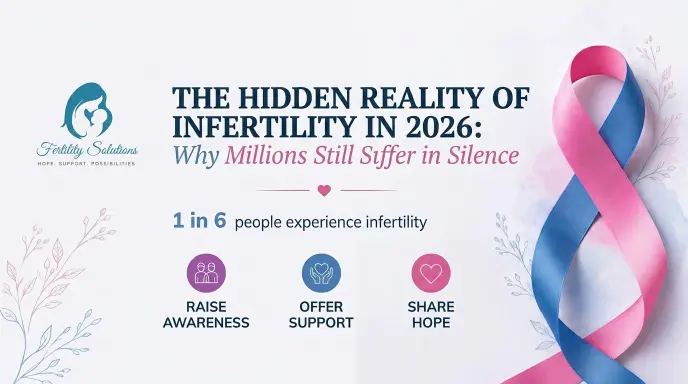
Published by Fertility Solutions | World Infertility Awareness Month 2026 | Week 1 of 4
At Fertility Solutions, we regularly hear from couples who tell us the same thing: they had no idea how many other people were going through exactly what they were. They had spent months — sometimes years — quietly enduring the monthly grief of a negative test, the clinical cold of a doctor’s examination room, and the exhausting work of pretending to the world that everything was fine. They felt alone in a crowd.
They were not alone. They never were. And as we mark World Infertility Awareness Month in June 2026, that is the single most important truth we can share.
The Numbers Behind the Silence
The World Health Organisation estimates that approximately 17.5% of the adult population — roughly 1 in 6 people worldwide — experience infertility at some point in their reproductive lives. That translates to an estimated 186 million individuals globally living with this condition at any one time. In South Africa, the picture is similarly stark: research consistently points to one in five to one in six couples experiencing difficulty conceiving, a figure that has not meaningfully improved over the past two decades.
Despite these numbers, infertility remains one of the most under-discussed medical conditions in our society. It sits at an uncomfortable intersection of medicine, identity, relationships, and culture — and in that discomfort, silence has flourished.
” 1 in 6 people worldwide experience infertility. Yet most will never speak openly about it. “
In South Africa specifically, the gap between the prevalence of infertility and the availability of treatment is particularly troubling. There are approximately 5,000 IVF cycles performed in South Africa annually — a number that, for a country of 60 million people, represents only a fraction of the couples who need care. By comparison, scaled to population size, that figure should be closer to 20,000 cycles per year. The reasons are complex: cost, access, awareness, and stigma all play a role.
What Is Infertility? A Definition That Matters
Before we can talk honestly about infertility, we need to be clear about what it means. According to the Southern African Society of Reproductive Medicine and Gynaecological Endoscopy (SASREG), infertility is defined as the inability to achieve a clinical pregnancy after 12 months or more of regular, unprotected sexual intercourse — or after six months if the female partner is 35 years or older.
This definition matters because it removes the ambiguity that so many couples carry with them. Infertility is not a moral failing. It is not a sign that someone is ‘not meant to be a parent.’ It is a medical condition — recognised as such by the World Health Organisation — and like most medical conditions, it can very often be diagnosed and treated.
It is also worth noting what infertility does not mean. It does not mean pregnancy is impossible. It means that without medical support, pregnancy has not occurred. And for most couples who seek help, there are options — and there is real hope.
Why We Still Suffer in Silence
If infertility is this common, why do so few people talk about it? The answer lies in a tangled web of cultural expectation, social pressure, and a profound lack of public education.
In many communities — both in South Africa and globally — fertility is tied to identity in ways that run very deep. For women, the expectation to bear children can feel inescapable, woven into family gatherings, social conversations, and everyday questions from well-meaning people who simply do not know better. For men, infertility often touches on deeply held ideas about masculinity and strength that make honest disclosure feel impossible.
The result is a collective silence that makes the experience of infertility far more isolating than it needs to be. Couples carry this quietly because they believe they are unusual — when in fact, in any given room, they are likely not alone at all.
” In South Africa, infertility carries a stigma that has not kept pace with medical understanding. That needs to change. “
There is also the matter of financial access. Unlike many countries where assisted reproductive technology is at least partially covered by health insurance or national health systems, South Africa’s fertility treatment landscape is almost entirely privately funded. This means that the burden of treatment — financially and emotionally — falls almost entirely on individuals, at the very moment when they are most vulnerable.
World Infertility Awareness Month: Why June Matters
June has been designated World Infertility Awareness Month by fertility advocacy communities and organisations worldwide. It is a month to shine light on the experiences of those navigating infertility, to correct misconceptions, to reduce stigma, and to ensure that people know that help exists.
At Fertility Solutions, we believe awareness is not just an act of kindness — it is an act of public health. When people understand that infertility is common, diagnosable, and often treatable, they are more likely to seek help sooner. Earlier intervention frequently leads to better outcomes.
This June, we are publishing a four-part series to mark World Infertility Awareness Month. Together, these articles form a reader journey: from understanding the scale of infertility, through its emotional impact, into its causes and diagnosis, and finally toward the treatments and technologies that offer real hope.
Key Facts for 2026
| Statistics at a Glance |
| 17.5% of adults worldwide — approximately 1 in 6 — experience infertility (WHO, 2023) |
| 186 million individuals globally are currently living with infertility |
| 1 in 5 to 1 in 6 South African couples face fertility challenges |
| Approximately 5,000 IVF cycles are performed annually in South Africa |
| Male factor infertility accounts for 40–55% of all infertility cases globally |
| Infertility has been recognised as a medical condition by the WHO |
| The majority of couples who seek treatment do achieve a pregnancy |
Frequently Asked Questions
Q: What is World Infertility Awareness Month?
World Infertility Awareness Month is observed every June. It is dedicated to raising awareness about infertility, reducing the stigma surrounding it, and educating the public about the causes, prevalence, and treatment options available.
Q: How many people are affected by infertility?
The World Health Organisation estimates that approximately 17.5% of adults — roughly 1 in 6 globally — experience infertility. In South Africa, this figure is consistent with global trends, with an estimated 1 in 5 to 1 in 6 couples affected.
Q: Is infertility more common in women or men?
Infertility affects both sexes equally. Research indicates that male factor infertility accounts for approximately 40–55% of all cases, female factors for 40–55%, and a combination of both or unexplained factors for the remainder.
Q: Does infertility mean I will never have children?
Not at all. Infertility is a medical condition indicating that pregnancy has not occurred without assistance. Most couples who seek evaluation and treatment do achieve a pregnancy, either naturally following diagnosis and treatment, or through assisted reproductive technologies.
The numbers tell one part of this story. But infertility is never just a statistic — it is a deeply personal experience that touches every part of a person’s life: their relationships, their identity, their mental health, and their sense of the future. Continue reading: World Infertility Awareness Month: The Emotional Weight of Infertility — Week 2 →