Most people describe their first fertility specialist appointment the same way: they went in nervous, got through it, and came home realising they hadn’t asked half the questions they’d meant to.
That’s not a failure of the patient. It’s the predictable result of walking into an unfamiliar medical setting, in an emotionally heightened state, with no map.
This guide is the map.
Before You Go — Preparation That Makes a Real Difference
What to Bring
Both partners should attend if possible. Fertility investigation involves both people from the start, and being there together means both hear the same information, can ask questions, and make decisions together.
- Any previous fertility test results (AMH, FSH, semen analysis, ultrasounds)
- Previous medical records relevant to reproductive health — surgical reports, diagnoses, prescriptions
- A list of all current medications (including supplements and vitamins)
- Your menstrual cycle history — note range of cycle lengths and any symptoms
- Details of any previous pregnancies, losses, or fertility treatment
If you’ve already had some tests done, our guide to understanding fertility test results will help you make sense of what you’re bringing to the appointment.
| Write down your three most important questions before you arrive. Appointment anxiety affects memory, and the questions you most want answered are the ones most likely to disappear under pressure. |
Before You Go: Know When You Should Be There
If you’re unsure whether it’s the right time to book a fertility appointment, our 6-month window guide explains the age-specific timelines — including when to seek help at 35, 38, and 40+.
The Consultation — What Actually Happens
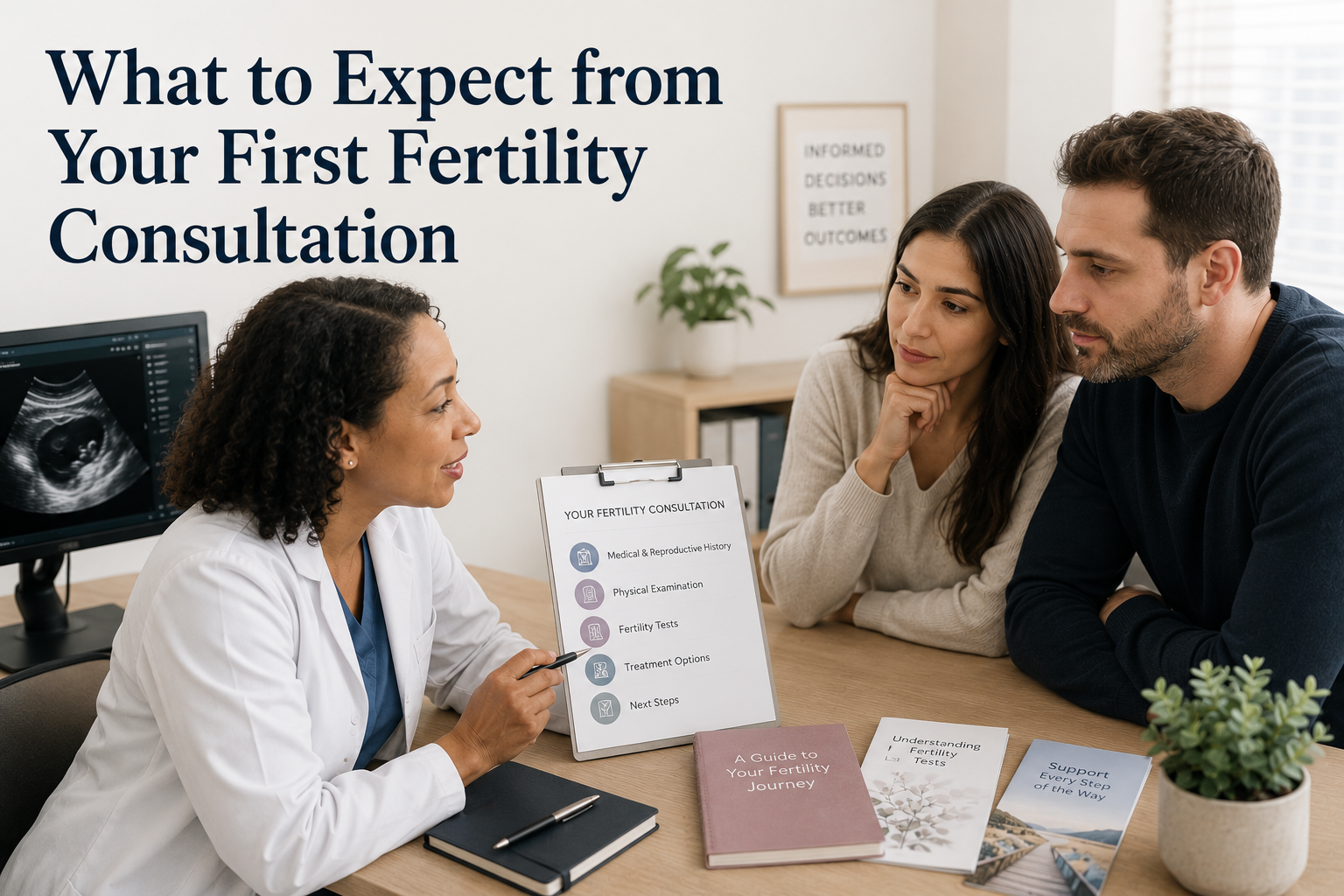
A typical first fertility consultation at a South African private clinic lasts approximately 45–60 minutes.
History Taking (15–20 minutes)
The specialist will go through your medical, reproductive, and lifestyle history in detail. Be as specific as possible. There is almost nothing in your history a fertility specialist hasn’t encountered.
Physical Examination
For women: a transvaginal ultrasound gives the specialist a direct view of the uterus and ovaries. They’ll count antral follicles (AFC), assess the uterine cavity, and look for signs of endometriosis or PCOS.
For men: a physical examination may be recommended if the semen analysis shows abnormalities — to check for varicocele, testicular volume, or structural issues.
Preliminary Assessment and Discussion
Based on history and available results, the specialist will give you a preliminary picture of what they’re seeing. This is not a definitive diagnosis — most findings require tests that take time.
The Plan
The consultation typically ends with an investigation plan. You may leave with:
- A blood test request form
- An ultrasound referral
- A semen analysis referral — read our complete guide to male fertility testing so you know what to expect
- A follow-up appointment date
- A prescription or recommendation for supplements while awaiting results
The Tests That Will Likely Be Ordered
For Women:
- AMH (Anti-Müllerian Hormone) — blood test, any day of your cycle. Explained in full in our fertility test results guide
- Day 3 FSH and Oestradiol — timed blood tests on Day 3 of your menstrual cycle
- LH (Luteinising Hormone) — often included in the Day 3 panel
- Thyroid function tests — thyroid disorders can significantly affect fertility
- Transvaginal ultrasound with AFC — may be done in-consultation or ordered separately
- HSG (Hysterosalpingogram) — X-ray of uterus and tubes — usually ordered after initial bloods
For Men:
- Semen analysis — the immediate priority. See our complete male fertility guide for what the results mean
- Hormonal panel (testosterone, FSH, LH, prolactin) if semen analysis is abnormal
For full detail on what each test measures and what the numbers mean, see our guide: AMH, FSH, AFC and your fertility test results explained.
Questions Worth Asking at Your First Appointment
- Based on what you’ve seen today, do you have any initial thoughts about what might be affecting our ability to conceive?
- What tests do you recommend, and in what order?
- Are there lifestyle changes you’d recommend for either of us while we await results?
- What are the possible treatment pathways? (For more context, see our IUI vs IVF vs ICSI guide)
- What are your clinic’s success rates by age group? (See also: how to choose a fertility clinic)
- What does medical aid cover at this stage? (See our medical aid coverage guide for a full breakdown)
- What should I do if I have questions between now and our next appointment?
After the Consultation — What Happens Next
TIMELINE: Blood test results typically take 3–7 days. Semen analysis: 24–48 hours. HSG is arranged within one menstrual cycle. Follow-up appointment to review results: 2–4 weeks after the consultation.
WHAT TO DO IN THE MEANTIME:
- Get recommended tests done promptly — don’t let the waiting period extend due to delays you control
- Note questions that come up as you wait — write them down for the next appointment
Once results are back, our guide to what a fertility diagnosis means for your chances will help you interpret the findings and prepare for the treatment conversation.
What If You’re an International Patient?
If you’re considering treatment in South Africa from abroad, a first consultation often happens remotely via video call. For more on choosing the right clinic and what to prepare, see our guide to choosing a fertility clinic in South Africa and our guide to South Africa as a fertility destination.
- Have any previous results scanned and shared with the clinic in advance
- Prepare a detailed written medical history to share beforehand
- Ask specifically about what monitoring can be done in your home country before travel
Myths vs Facts
Myth: The specialist will tell me what to do and I just follow the plan.
Fact: The best specialists present options and explain the reasoning. You are a participant in the decision. If you feel you’re not being given explanation, ask for more information or a second opinion.
Myth: Everything will be figured out at the first appointment.
Fact: The first consultation is the beginning of an investigation. Most diagnoses require multiple test results reviewed together.
Myth: I need to have all the answers before the appointment.
Fact: The specialist’s job is to ask the right questions. Your job is to be honest and thorough.
People Also Ask
Q: What happens at your first fertility appointment?
A: A first fertility appointment involves a detailed medical and reproductive history, a physical examination including transvaginal ultrasound, a review of existing results, and a discussion of what tests to order. It lasts approximately 45–60 minutes and ends with an investigation plan.
Q: Should both partners attend the first fertility consultation?
A: Yes — wherever possible. Both partners’ history is relevant from the start, and both benefit from hearing the same information and being able to ask questions.
Q: How long does a fertility workup take?
A: A complete fertility workup typically takes 4–8 weeks from first consultation to results review. Semen analysis: 24–48 hours. AMH: 3–7 days. HSG and AFC require cycle timing.
Q: How much does a first fertility consultation cost in South Africa?
A: Initial specialist consultations cost approximately R1,500–R3,000. Investigation of infertility is a Prescribed Minimum Benefit — most medical aids will cover the diagnostic workup.
Practical Takeaways
- Both partners should attend if possible — fertility investigation involves two people from the start
- Prepare your medical history, existing results, and your three most important written questions before you go
- The first consultation is the beginning of an investigation, not a definitive diagnosis
- You are a participant in the decision — ask questions, ask for reasoning, ask what the alternatives are
- For international patients: most SA clinics offer remote consultations. See why South Africa is a top fertility destination
Disclaimer: This content is for educational purposes only and does not constitute medical advice. Always consult with a qualified healthcare provider before making decisions about fertility treatment.
About the Author
Leigh-Ann Geydien is the founder of Fertility Solutions, South Africa’s only dedicated fertility directory. With a deep commitment to patient advocacy, she built the platform to bridge the gap between those navigating fertility challenges and the clinics and reproductive health specialists best placed to help them.