When your specialist first mentions assisted reproduction, the alphabet can feel like a wall: IUI, IVF, ICSI, FET, PGT-A. The consultations are short. The acronyms multiply. And somewhere in all of it, you’re expected to make decisions about treatments that cost tens of thousands of rands and carry real emotional weight.
This article cuts through the noise. It explains what each of the three main fertility treatments actually involves, who each one is genuinely appropriate for, what the success rate data shows in South Africa and globally, and — crucially — what the cost difference means in practice. For the complete investigation picture before choosing treatment, see our fertility test results guide.
The Three Treatments at a Glance
| IUI | IVF | ICSI | |
| Full name | Intrauterine Insemination | In Vitro Fertilisation | Intracytoplasmic Sperm Injection |
| Where fertilisation happens | Inside the body | Outside the body (lab) | Outside the body (lab) |
| Invasiveness | Low | High | High |
| Average SA cost per cycle | R4,000–R15,000 | R45,000–R100,000+ | Included in IVF or R5,000–R15,000 extra |
| Success rate per cycle (general) | 10–20% | 30–50% (under 35) | Similar to IVF |
| Best suited for | Mild male factor, unexplained infertility, donor sperm | Tubal issues, PCOS, moderate-to-severe male factor, older age | Severe male factor, previous fertilisation failure |
IUI: The Least Invasive Option
What IUI actually involves
IUI — intrauterine insemination — is the simplest form of assisted reproduction. Here’s what happens in a typical cycle:
- You may take oral medication (Clomid or Letrozole) or low-dose injectable gonadotrophins to encourage one or two follicles to develop. Or the cycle may be ‘natural’ — no stimulation.
- Your clinic monitors your cycle with blood tests and ultrasound scans to track follicle growth and predict ovulation.
- When ovulation is imminent, a semen sample from your partner or a donor is prepared in the lab — ‘washed’ to concentrate the best-motility sperm and remove seminal fluid.
- A thin catheter is passed through your cervix and the prepared sperm is placed directly into the uterus. The procedure itself takes less than five minutes. Most women describe mild cramping — the experience is closer to a smear test than a surgical procedure.
- Fourteen days later, a pregnancy test.
Who IUI is genuinely appropriate for
IUI works by improving the odds of sperm reaching an egg in the fallopian tube. It only works if there is at least one open fallopian tube and sperm quality is at least moderate.
The clearest indications for IUI include:
- Unexplained infertility in younger women (under 35–37): a reasonable first-line approach before escalating to IVF. See our unexplained infertility guide.
- Mild male factor infertility: low-moderate sperm count or motility that could benefit from the head start IUI provides.
- Donor sperm: for single women or same-sex female couples, IUI is the standard first approach — and often successful without the need for IVF.
- Cervical factor infertility: where the cervical environment is hostile to sperm, IUI bypasses that barrier entirely.
When IUI is NOT the right choice
IUI should generally not be the treatment of choice when:
- Both fallopian tubes are blocked or compromised
- Severe male factor infertility — see our male fertility guide for what ‘severe’ means and what the options are
- The female partner is 38 or older and has been trying for some time — time is better used on IVF
- Moderate-to-severe endometriosis — see our endometriosis and fertility guide
| The evidence shows that beyond three to four stimulated IUI cycles, the per-cycle success rate does not improve and the cumulative time cost becomes significant. Most specialists will review the plan after three unsuccessful cycles. |
IUI success rates in context
The average success rate per IUI cycle is approximately 10–20%, depending on age and diagnosis. This is lower than IVF, but IUI cycles are significantly cheaper and far less invasive. The comparison that matters is cumulative success over multiple cycles vs a single IVF cycle — and this calculation changes with age.
For a 33-year-old with unexplained infertility, three IUI cycles at R8,000 each (R24,000 total) with a cumulative pregnancy rate of 35–40% may be a reasonable first step before considering IVF. For a 38-year-old with borderline ovarian reserve, the same approach would likely not be recommended. Check what your AMH result actually means before making this decision.
IVF: The Most Widely Known Fertility Treatment
What IVF actually involves
IVF — in vitro fertilisation — is the process of stimulating the ovaries to produce multiple eggs, retrieving those eggs, fertilising them in a laboratory, and transferring the resulting embryo(s) back to the uterus. A standard IVF cycle moves through these phases:
- Ovarian stimulation (10–14 days): You self-inject hormone medications (gonadotrophins) daily to stimulate multiple follicles to grow simultaneously. This is monitored closely with blood tests and ultrasound — typically 3–5 clinic visits during this phase.
- Trigger injection: When follicles reach the right size, a trigger injection (usually hCG or a GnRH agonist) matures the eggs.
- Egg retrieval (day procedure): 36 hours after the trigger, eggs are retrieved under light sedation using a needle guided by ultrasound. The procedure takes 20–30 minutes. You go home the same day and typically need one day of rest.
- Fertilisation and culture (3–6 days): Your eggs and partner’s sperm are combined in the lab. Embryologists monitor development over the next 3–5 days. You receive daily progress updates.
- Embryo transfer: One or two embryos are transferred to the uterus via a catheter — a procedure similar to IUI in terms of sensation. Remaining viable embryos are frozen for future use.
- Two-week wait: Then a pregnancy blood test. For how to get through those 14 days, see our two-week wait guide.
Who IVF is appropriate for
IVF is appropriate for a broader range of diagnoses than IUI, and becomes the recommended approach when:
- Tubal factor infertility: Blocked or absent fallopian tubes. IVF bypasses the tubes entirely.
- Moderate-to-severe endometriosis where other approaches have not succeeded — see our endometriosis guide
- Significant ovarian dysfunction or PCOS where ovulation induction has not resulted in pregnancy — see our PCOS and fertility guide
- Repeated IUI failure: After 3–4 unsuccessful IUI cycles, IVF is typically recommended.
- Advanced maternal age (38+): Where time makes escalating directly to IVF more appropriate.
- Low ovarian reserve: Where the priority is retrieving and banking eggs or embryos efficiently.
- When genetic testing of embryos (PGT-A) is indicated — only possible with IVF.
IVF success rates in South Africa
| Age Group | Live Birth Rate per Transfer (approximate) | Key Note |
| Under 35 | 40–55% | Best outcomes; most embryos chromosomally normal |
| 35–37 | 35–45% | Modest decline; still strong outcomes |
| 38–39 | 25–35% | More significant decline; egg quality increasingly variable |
| 40–42 | 15–25% | Lower but meaningful success still possible |
| Over 42 (own eggs) | 5–15% | Egg donation discussion often appropriate by this point |
IVF in South Africa ranges from approximately R45,000 per cycle at the most accessible accredited clinics to R100,000 or more at premium centres. The public sector offers means-tested subsidised IVF at Groote Schuur (Cape Town), Tygerberg (Bellville), and Steve Biko (Pretoria) for qualifying patients at approximately R6,700 per cycle. For a full breakdown, see our IVF cost guide for South Africa.
| Important: Single-cycle success rates can be misleading. Cumulative success over multiple cycles (including frozen embryo transfers from the same retrieval) is a more meaningful metric. Discuss this with your specialist when reviewing statistics. |
ICSI: IVF With a Crucial Difference
What makes ICSI different from IVF
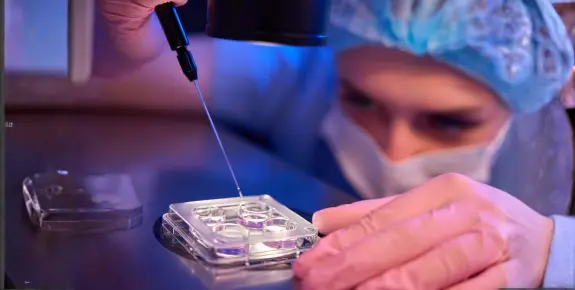
ICSI — intracytoplasmic sperm injection — is not a separate treatment from IVF. It is a laboratory technique used during the fertilisation step of an IVF cycle. In standard IVF fertilisation, eggs and sperm are placed together in a dish and left to fertilise naturally overnight. In ICSI, a single sperm is selected and injected directly into the egg using a microscopic needle. The embryo development from that point is identical to standard IVF.
ICSI was developed specifically to address severe male factor infertility — situations where natural fertilisation (even in a dish) is unlikely because sperm quality is too poor to penetrate the egg. For the full picture on male fertility assessment, see our male fertility guide.
When ICSI is the appropriate choice
ICSI is recommended when:
- Severe male factor infertility: Very low sperm count (severe oligospermia), very poor motility, or high abnormal morphology.
- Azoospermia: No sperm in ejaculate. Sperm can sometimes be surgically retrieved from the epididymis (PESA) or testis (TESA/TESE) and used with ICSI.
- Previous IVF cycle with failed or very poor fertilisation: Where standard IVF fertilisation did not work well.
- Surgically retrieved sperm: ICSI ensures each retrieved sperm is used as efficiently as possible.
- Frozen sperm: Similar logic — ICSI maximises the use of limited samples.
ICSI success rates
When ICSI is used for appropriate cases, fertilisation rates are generally very good — typically 70–80% of injected eggs fertilise. Overall cycle success rates (live birth per transfer) are broadly comparable to IVF when patient selection is similar. ICSI solves the fertilisation problem; it does not overcome other issues affecting implantation or egg quality.
ICSI adds approximately R5,000–R15,000 to an IVF cycle at most South African clinics, and is often included in the quoted IVF price — confirm with your clinic. See our IVF cost guide for what’s typically included.
The Decision Framework
Start with IUI if:
- You are under 37
- At least one fallopian tube is confirmed open (checked via HSG — hysterosalpingogram)
- Your partner’s semen analysis is at least borderline acceptable
- You are using donor sperm
- Your specialist confirms no significant structural or tubal issues
Move to (or start with) IVF if:
- Tubes are blocked
- You are 38 or older
- Multiple IUI cycles have failed
- Significant endometriosis is present
- Ovarian reserve is low
- Your specialist recommends it based on your full investigation
Add ICSI (within IVF) if:
- Severe male factor infertility is confirmed
- Previous IVF cycle had poor fertilisation
- Sperm is surgically retrieved
- Your clinic’s embryology team recommends it
| IUI is not ‘IVF-lite.’ It is a genuinely different treatment with different appropriate uses. Whether it’s the right starting point depends on your age, diagnosis, and reserve — not on cost alone. And IVF is not always better than IUI for couples where IUI is genuinely appropriate — the additional cost, physical impact, and emotional intensity of IVF are not trivial. |
What Your Medical Aid Covers
Some South African medical aid plans cover IVF — Discovery Health’s Top plans now include an IVF benefit, subject to terms and conditions including age limits and cycle limits. Most restricted and mid-tier plans do not cover IVF, though all plans are required to cover the investigation of infertility. For the full picture, see our medical aid and fertility coverage guide.
People Also Ask
Q: How many IUI cycles should I try before moving to IVF?
A: The standard recommendation is three to four stimulated IUI cycles before reviewing and considering IVF. After three or four failed cycles with no pregnancy, most specialists will recommend reassessment and discuss whether IVF is the more appropriate next step. The calculation changes with age — older patients are typically moved to IVF earlier.
Q: Is ICSI better than IVF?
A: ICSI is not inherently ‘better’ than conventional IVF fertilisation. It is more effective when sperm quality is poor, because it bypasses the need for sperm to penetrate the egg. For couples with normal sperm, the outcomes are broadly comparable. ICSI is appropriate when there is a clinical reason to use it — not as a blanket upgrade.
Q: What is the success rate of IUI in South Africa?
A: IUI success rates per cycle in South Africa are broadly 10–20%, depending on age, stimulation protocol, and diagnosis. Younger women with donor sperm and no structural issues tend to achieve rates toward the higher end. Cumulative success over three cycles can reach 35–45% in optimal candidates.
Q: Can I choose IVF instead of IUI to increase my chances?
A: Yes — and in some cases this is the right decision. If you are 37 or older, have borderline results, or have a time-sensitive situation, your specialist may recommend starting directly with IVF. For younger patients with no complicating factors, the stepwise approach (IUI first) is typically recommended. This should be a discussion with your specialist, informed by your full investigation.
Practical Takeaways
- IUI, IVF, and ICSI are not a hierarchy from ‘less good’ to ‘more good’ — they are different tools for different clinical situations.
- The right treatment depends on your diagnosis, age, and what investigation reveals about both partners — not on what you’ve read online. Start with understanding your test results and what your diagnosis means for your chances.
- Cost is a legitimate factor in treatment planning. For SA-specific cost comparisons, see our IVF cost guide.
- If you’re unsure whether you’ve had the right investigations — AMH, AFC, Day 3 FSH, semen analysis, tubal assessment — that conversation should happen at your first fertility consultation.
Disclaimer: This article is for educational purposes only and does not constitute medical advice. All treatment decisions should be made in consultation with a qualified reproductive medicine specialist. Cost estimates are indicative and should be confirmed directly with your clinic.
About the Author
Leigh-Ann Geydien is the founder of Fertility Solutions, South Africa’s only dedicated fertility directory. With a deep commitment to patient advocacy, she built the platform to bridge the gap between those navigating fertility challenges and the clinics and reproductive health specialists best placed to help them.
References: Verhulst SM et al. (2022). IUI versus expectant management. Cochrane Database. | SASREG clinical guidelines.