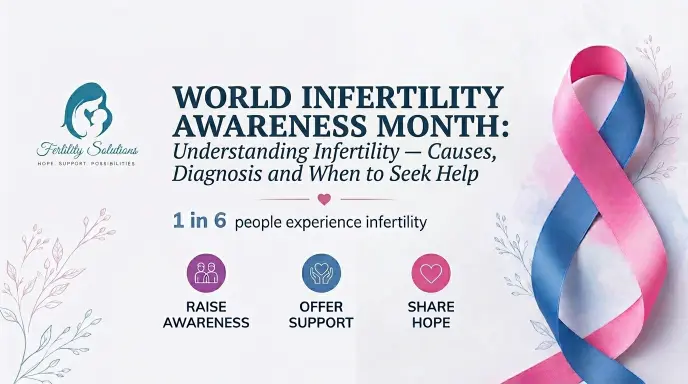
Published by Fertility Solutions | World Infertility Awareness Month 2026 | Week 3 of 4
At Fertility Solutions, we believe that knowledge is one of the most compassionate gifts we can offer anyone navigating the uncertainty of infertility. As we have explored in our first article on the global statistics that define the scale of this challenge, and in our second article on the emotional weight that so often accompanies a diagnosis — understanding the ‘why’ is often the first thing people want and the last thing they feel equipped to ask for. This week, we address that directly.
A Condition Without a Single Face
One of the most important things to understand about infertility is that it does not have a single cause. It is not one condition — it is many possible conditions, in many possible combinations, presenting differently in different people. This is why the path to diagnosis can feel slow and uncertain, and why a thorough, methodical approach to testing matters so much.
Broadly, infertility is categorised by its origin: female factor, male factor, combined factor, or unexplained. This categorisation shapes the diagnostic process and, ultimately, the treatment pathway.
Female Factor Infertility
Female factor infertility accounts for approximately 40–55% of all infertility cases. The most common causes include:
| Common Female Causes |
| Polycystic Ovary Syndrome (PCOS): The most common hormonal disorder in women of reproductive age, affecting ovulation and egg release. PCOS is associated with irregular periods, excess androgens, and small cysts on the ovaries. |
| Endometriosis: A condition in which tissue similar to the uterine lining grows outside the uterus. It can affect the fallopian tubes, ovaries, and pelvic cavity, and is a significant cause of both infertility and chronic pain. |
| Fallopian tube damage or blockage: Often the result of previous pelvic inflammatory disease (PID), sexually transmitted infections, or prior surgery. Blocked tubes prevent sperm from reaching the egg. |
| Diminished ovarian reserve: A reduction in the quantity or quality of remaining eggs. Can occur naturally with age (particularly after 35) or as a result of medical treatment, surgery, or genetic conditions. |
| Uterine abnormalities: Including fibroids, polyps, or structural issues that can interfere with implantation or pregnancy maintenance. |
| Premature ovarian insufficiency (POI): Where the ovaries stop functioning normally before age 40. |
| Thyroid disorders: Both hypothyroidism and hyperthyroidism can interfere with ovulation and pregnancy. |
| Age-related decline in egg quality: Egg quality declines significantly after 35 and more sharply after 40. |
Male Factor Infertility
Male factor infertility is responsible for approximately 40–55% of all cases — yet it is still, culturally, the dimension of infertility that is least spoken about. This imbalance does real harm: it delays diagnosis, increases emotional burden for women who undergo unnecessary investigation, and prevents men from receiving care and support they need.
| Common Male Causes |
| Low sperm count (oligozoospermia): Fewer sperm than normal in the ejaculate, reducing the probability of fertilisation. |
| Poor sperm motility (asthenozoospermia): Sperm that cannot swim effectively enough to reach and penetrate the egg. |
| Abnormal sperm morphology (teratozoospermia): Sperm with structural abnormalities that reduce their ability to fertilise. |
| Azoospermia: The complete absence of sperm in the ejaculate. May be obstructive (due to blockage) or non-obstructive (due to production failure). |
| Varicocele: Enlarged veins in the scrotum that can impair sperm production by raising testicular temperature. |
| Hormonal imbalances: Including low testosterone or other endocrine disruptions. |
| Genetic conditions: Such as Klinefelter syndrome or Y chromosome microdeletions. |
| Lifestyle factors: Including smoking, excessive alcohol, recreational drug use, anabolic steroids, obesity, and heat exposure to the genitals. |
Unexplained Infertility
Unexplained infertility — where standard investigations reveal no identifiable cause — accounts for approximately 15–30% of cases. This is one of the most challenging diagnoses to receive emotionally: having a name for your condition without having a reason for it.
It is important to know that ‘unexplained’ does not mean ‘untreatable.’ Many couples with unexplained infertility go on to conceive, either naturally over time or with the assistance of fertility treatments. What it does mean is that the investigation needs to be thorough — and that the diagnostic process has limits.
” An ‘unexplained’ diagnosis is not the end of the road. It is an invitation to look further and explore what options remain. “
How Is Infertility Diagnosed?
A thorough fertility evaluation will typically include the following components, though the exact process varies based on history, age, and clinical presentation:
| Fertility Testing for Women |
| Hormonal blood tests: FSH, LH, AMH, oestradiol, TSH, prolactin — to evaluate ovarian reserve and hormonal function |
| Antral Follicle Count (AFC): Ultrasound count of developing follicles to assess ovarian reserve |
| Hysterosalpingography (HSG): An X-ray procedure to evaluate the shape of the uterine cavity and check if the fallopian tubes are open |
| Pelvic ultrasound: To assess uterine structure, identify fibroids or polyps, and evaluate the ovaries |
| Laparoscopy: A surgical procedure used to diagnose endometriosis, pelvic adhesions, or other structural issues not visible on imaging |
| Fertility Testing for Men |
| Semen analysis: The cornerstone of male fertility evaluation — assessing sperm count, motility, morphology, and volume |
| Hormonal blood tests: Testosterone, FSH, LH, prolactin to evaluate testicular function |
| Scrotal ultrasound: To identify varicoceles or structural issues |
| Genetic testing: In cases of azoospermia or severely abnormal semen parameters |
| Testicular biopsy: In selected cases of non-obstructive azoospermia to assess sperm production |
When Should You See a Fertility Specialist?
The timing of when to seek specialist help is one of the questions we hear most frequently. The general guidance — based on clinical consensus from SASREG and the ASRM — is as follows:
| Situation | Guidance |
| Under 35 years | Seek specialist evaluation after 12 months of regular unprotected intercourse without conception |
| 35–37 years | Seek evaluation after 6 months |
| 38 years and older | Seek evaluation as soon as possible — ideally without delay |
| Any age — certain conditions | Seek evaluation immediately if: irregular or absent periods, known PCOS or endometriosis, prior pelvic surgery or infection, two or more miscarriages, known male factor issue |
| Men — any age | Seek evaluation without waiting if there are known issues with sperm, a history of testicular problems, or if a female partner has been advised to investigate |
Frequently Asked Questions
Q: What is unexplained infertility?
Unexplained infertility is diagnosed when standard fertility tests — including hormone levels, ovarian reserve, fallopian tube assessment, uterine evaluation, and semen analysis — return within normal ranges, but conception has not occurred after the expected timeframe. It accounts for roughly 15–30% of cases and does not preclude treatment or conception.
Q: How long does a fertility assessment take?
An initial consultation with a fertility specialist typically takes one to two hours. The full evaluation — including blood tests, ultrasound, and semen analysis — may take between one and three weeks, depending on the timing of your menstrual cycle and the tests required.
Q: Can lifestyle factors cause infertility?
Yes, for both women and men. Smoking, excessive alcohol, recreational drug use, obesity, extreme under-weight, high-stress levels, and exposure to environmental toxins have all been associated with reduced fertility. Addressing these factors is often part of initial fertility guidance.
Q: Is a semen analysis the same as a fertility test for men?
A semen analysis is the primary and most accessible fertility test for men, providing essential information about sperm count, movement, and structure. However, hormonal tests, genetic screening, and physical examination may be recommended depending on the results.
Having a clearer picture of the causes and diagnosis of infertility changes how people approach their own journeys. If you are joining us mid-series, you can catch up on Article 1: The Hidden Reality of Infertility and Article 2: World Infertility Awareness Month — The Emotional Weight of Infertility. Next week, we explore the full landscape of treatment options — IVF, ICSI, egg donation, and the advances shaping the future of reproductive medicine.
| ← Previously in this series World Infertility Awareness Month: The Emotional Weight of Infertility — The Conversations We Need to Have |