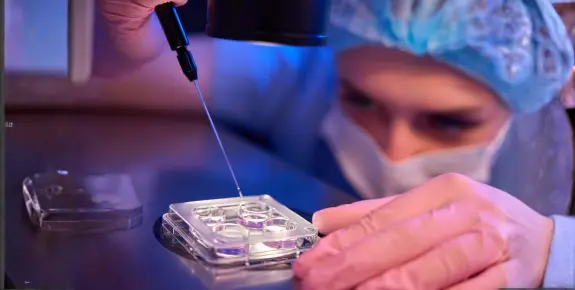

The Laboratory Has Changed Significantly
When vitrification became the standard for embryo cryopreservation roughly a decade ago, it represented one of the most clinically meaningful advances in IVF since the technique’s inception. The shift from slow freezing to ultra-rapid vitrification dramatically improved post-thaw survival rates for both embryos and oocytes —
making frozen embryo transfers genuinely comparable, and in some analyses superior in certain contexts, to fresh cycles. The implications were significant: egg freezing became a clinically viable fertility
preservation option. Freeze-all cycles became a legitimate strategy for patients at risk of ovarian hyperstimulation. And the ability to safely defer transfer while optimising endometrial conditions became a real part of clinical practice. This was not incremental progress. It was a genuine paradigm shift, and the
downstream effects on patient care have been substantial.
Time-Lapse Imaging and AI-Assisted Selection
The development of time-lapse embryo monitoring systems introduced something previously unavailable in IVF laboratories: continuous, undisturbed observation of embryo development from fertilisation to blastocyst stage.
The initial clinical promise was significant — the ability to observe morphokinetic parameters offered a richer data set for embryo selection than the standard static snapshots at defined developmental checkpoints. The evidence around whether time-lapse imaging actually improves live birth rates compared to conventional
selection, however, has been more mixed than early enthusiasm suggested. Multiple RCTs have produced variable results, and the technology’s value appears to depend significantly on whether it is used in conjunction with validated morphokinetic scoring systems by experienced embryologists.
Artificial intelligence applications in embryo assessment represent the next iteration of this development. Machine learning models trained on large embryo image datasets have demonstrated competitive performance with experienced embryologists in some studies — and the potential for AI to assist, rather than replace, expert human assessment is a genuinely interesting frontier. The critical word is assist. The technology is not yet at a point where autonomous embryo selection is clinically appropriate, and the regulatory and ethical frameworks around AI in assisted reproduction are still developing.
Endometrial Receptivity — An Area of Active Development
For years, embryo quality received the majority of laboratory and clinical attention in IVF. The endometrium — its receptivity, its immunological environment, its microbiome — has more recently become the focus of significant research investment, and rightly so. Endometrial receptivity analysis (ERA) testing, designed to identify the personalised window of implantation, has been widely adopted in some clinical settings — particularly for patients with recurrent implantation failure. The evidence base for ERA in unselected populations is less compelling than its widespread use might suggest, and a well-designed RCT published in the New England Journal of Medicine in 2021 did not demonstrate improved live birth rates in a general IVF
population. The ongoing investigation of the endometrial microbiome — and its potential influence on implantation outcomes — represents an area where the science is genuinely evolving. The clinical translation of this research is still in development, and practitioners should approach commercially available microbiome tests with appropriate evidential scrutiny.
What Has Not Changed Enough
Despite genuine technological progress, several fundamental challenges in IVF remain unresolved. Patient access is the most significant. The cost of IVF remains prohibitive for the majority of the global population who need it. The geographic distribution of quality ART services remains profoundly inequitable — concentrated in high-income urban centres, largely inaccessible across much of Sub-Saharan Africa, South Asia, and Latin America. Technology cannot close that gap without deliberate policy, pricing, and infrastructure change. The psychological experience of IVF has not kept pace with clinical progress. The laboratory may be more sophisticated than it was ten years ago. The emotional support available to patients navigating that laboratory has, in most settings, not
changed significantly.
Progress Worth Acknowledging. Problems Worth Naming.
The advances in IVF technology over the past decade are real, clinically meaningful, and worth celebrating. The science is better. The outcomes, for many patients in many circumstances, are better. But progress in the laboratory must be paired with progress in how we support the humans who depend on it. For those working at the frontier of reproductive technology — what development in the last five years has most changed your clinical
practice? And where do you see the most important unmet need?