
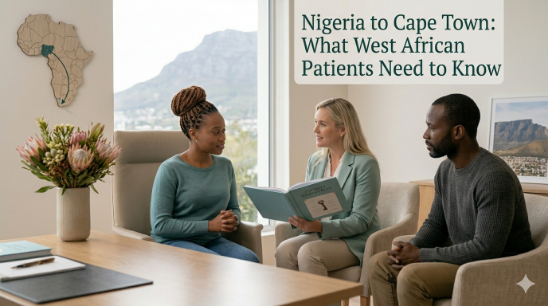
For growing numbers of patients from Nigeria, Ghana, Kenya, and across West and East Africa, South Africa has become the destination of choice for fertility treatment that combines internationally accredited standards with costs that remain significantly below those of European or US alternatives.
The decision to travel for fertility treatment is not made lightly. It involves research, trust, logistical planning, and a degree of courage. This guide is designed to give West African patients — particularly those travelling from Nigeria — an honest, specific, and practical overview of what to expect from start to finish.
Why Do West African Patients Choose South Africa?
Clinical standards comparable to Europe — at a fraction of the cost
South Africa’s SASREG-accredited fertility clinics operate to standards comparable to leading European and North American centres. The embryology laboratories, specialist credentials, and clinical protocols are internationally validated. For a full picture of why South Africa is a top fertility destination, see our dedicated guide.
The cost advantage
| Treatment | South Africa (ZAR) | South Africa (USD approx) | USA (USD) | UK (GBP) |
|---|---|---|---|---|
| IVF with ICSI | R45,000–R100,000 | $2,500–$6,000 | $15,000–$25,000 | £5,000–£8,000 |
| Egg donation IVF | R65,000–R110,000 | $3,500–$7,000 | $25,000–$50,000 | £10,000–£18,000 |
| Frozen embryo transfer | R15,000–R25,000 | $800–$1,500 | $3,000–$5,000 | £1,500–£2,500 |
At current exchange rates, Nigerian patients benefit from a significant rand/naira advantage. Even accounting for flights and accommodation, total treatment costs in South Africa are typically 60–80% below equivalent US costs.
Ethnically diverse donor pool
For Nigerian patients requiring egg donation, South Africa’s donor pool is one of the most ethnically diverse in the world — reflecting the country’s demographics. This is a major advantage for patients who need a donor of West African, East African, or mixed ethnic heritage. Most SA egg donation agencies, including FertilityMate, maintain databases specifically including Black African donors.
Shorter waiting times than Europe
In the UK, egg donation waiting times can be 2–3 years due to strict anonymity rules creating donor shortages. Most SA clinics complete the matching process in weeks to a few months.
The Practical Journey — Step by Step
Step 1: Remote Consultation
The process begins with a remote consultation — typically a video call — with a specialist at your chosen South African clinic. Most internationally-facing SA clinics offer this as standard and are experienced in working with West African patients. You’ll need to share any previous fertility investigation results in advance. If you haven’t had a workup yet, basic tests — AMH, FSH, semen analysis — can be arranged in Nigeria before travel.
Step 2: Pre-travel Investigations
Your SA clinic will advise on what tests can be done in Nigeria before you travel. Typically:
- AMH blood test — available at major private pathology laboratories in Lagos, Abuja, and Port Harcourt
- Day 3 hormonal panel (FSH, LH, oestradiol) — similarly available
- Semen analysis — available at reproductive medicine clinics in major Nigerian cities
- Any previous scan reports, surgical notes, or investigation results — share these with the SA clinic in advance
Step 3: South African Visa
Nigerian citizens require a visa to enter South Africa. For fertility treatment travel, you’ll apply for a Medical Visa (or a standard short-stay visitor visa if the treatment period is short). Key points:
- A letter from your treating SA clinic confirming the reason for travel and approximate duration is typically required
- Apply well in advance — SA visa processing from Nigeria can take several weeks
- A fertility concierge can assist with preparing the supporting documentation required
- Most IVF cycles require approximately 3–4 weeks in Cape Town. Egg donation cycles may require 2–3 weeks, or longer if fresh donor synchronisation is needed
Step 4: In Cape Town — What the Cycle Looks Like
Once in Cape Town, the treatment process follows the standard protocol described in our complete IVF guide. For an IVF cycle, you’ll have approximately 5–8 monitoring appointments during the stimulation phase (days 2–14), followed by egg retrieval under sedation, laboratory fertilisation, and embryo transfer. All of this takes place within your SA clinic.
ACCOMMODATION: Cape Town has a wide range of accommodation options suited to medical travel. Many patients in fertility treatment choose self-catering apartments in the Southern Suburbs (close to Cape Fertility, Aevitas) or the Northern Suburbs (close to Wijnland Fertility). Staying in self-catering accommodation allows you to manage your own diet and rest schedule, which matters during stimulation.
Approximate accommodation cost: R8,000–R25,000 for 3–4 weeks, depending on the area and standard. Full cost context is in our IVF cost guide for South Africa.
Step 5: Post-Transfer and Return
After embryo transfer, most clinics recommend 1–2 days of rest before normal activity. The two-week wait — the 14 days between transfer and pregnancy blood test — can be spent in Cape Town or, with clinic agreement, back in Nigeria if the timing allows. The blood test (beta-hCG) can be done at a Nigerian laboratory and results shared with your SA clinic. Most clinics are experienced in managing this remotely.
What West African Patients Should Prepare For
The emotional weight of fertility travel
Travelling for fertility treatment — away from your support network, in an unfamiliar environment, during one of the most emotionally demanding experiences of your life — is genuinely hard. Many Nigerian patients describe feeling isolated during the process. Planning for this matters:
- If your partner or a close friend can travel with you, this is strongly advisable
- Connect with other Nigerian patients who have travelled to SA for treatment — online communities exist and can provide both practical advice and emotional solidarity
- Consider engaging a fertility concierge with experience in international patient navigation — this is where independent, end-to-end logistical and emotional support has the most impact
Medical terminology and communication
South African fertility clinics are predominantly English-speaking — this is not typically a language barrier for Nigerian patients. However, the clinical terminology and the pace of information delivery can still feel overwhelming. Preparation is key: use our guides (especially our guides to
Financial planning
Naira-to-rand exchange rates fluctuate and can significantly affect total cost. Budget in rands where possible, and consider transferring funds in advance when rates are favourable. For finance options, see Fertility Solutions finance. Note that South African medical aid does not extend to international patients — treatment is paid privately.
What to Look for in a South African Clinic as a Nigerian Patient
- SASREG accreditation — non-negotiable baseline
- Experience with international patients, specifically from West Africa
- A patient coordinator who is experienced in supporting non-SA patients through the administrative process
- An ethnically diverse egg donor pool — if egg donation is relevant (see egg donation guide)
- Willingness to conduct the initial consultation remotely and support the pre-travel workup process
For clinic recommendations specific to your diagnosis and situation, a fertility concierge who knows the SA landscape can provide independent guidance — without a referral fee conflict of interest.
Myths vs Facts for Nigerian Patients
Myth: Fertility treatment in SA is only accessible to wealthy Nigerians.
Fact: While the cost is significant, a complete IVF cycle in South Africa costs approximately USD $3,000–$6,000 — including clinic fees and medication — plus travel and accommodation. This is a fraction of US or European costs, and for many Nigerian patients represents a meaningful advantage over domestic private fertility options.
Myth: I need to stay in SA for the whole treatment cycle.
Fact: For IVF, the stimulation and retrieval phase requires approximately 3–4 weeks. For frozen embryo transfers, some clinics can conduct monitoring remotely, with only the transfer itself requiring travel. Ask your clinic what can be managed in Nigeria.
Myth: SA clinics don’t have Black African egg donors.
Fact: South Africa’s donor pool is one of the most ethnically diverse in the world, including a significant pool of Black African donors of various ethnic backgrounds. Most agencies maintain specific databases for this demographic.
People Also Ask
Q: Can I do IVF in South Africa as a Nigerian patient?
A: Yes. South Africa’s fertility clinics are open to international patients, including those from Nigeria. The process typically begins with a remote consultation, followed by pre-travel investigations, a South African medical visa, and approximately 3–4 weeks in-country for the stimulation and retrieval phase.
Q: How much does IVF cost in South Africa for Nigerian patients?
A: IVF with ICSI costs approximately R45,000–R100,000 (roughly USD $2,500–$6,000 at current exchange rates). Adding flights, accommodation, and medications, total costs for a Nigerian patient for a single IVF cycle in Cape Town are approximately $5,000–$10,000 — significantly below equivalent treatment in the UK or USA.
Q: Is egg donation from a Black African donor available in South Africa?
A: Yes. South Africa has one of the most ethnically diverse egg donor pools in the world, including a significant pool of Black African donors. Most SASREG-accredited egg donation agencies maintain specific databases for this demographic. Waiting times are typically weeks to a few months.
Q: Do I need a visa to travel to South Africa for fertility treatment?
A: Yes. Nigerian citizens require a visa to enter South Africa. For medical travel, a Medical Visa application supported by a letter from your treating clinic is the most appropriate route. Apply well in advance — processing from Nigeria can take several weeks.
Practical Takeaways
- South Africa’s SASREG-accredited fertility clinics offer internationally competitive standards at a significant cost advantage over the UK, USA, and many UAE options
- The process begins remotely — most clinics conduct the initial consultation by video call, and pre-travel investigations can be done in Nigeria
- South Africa has a large, ethnically diverse egg donor pool — including Black African donors — making it a particularly strong option for Nigerian patients requiring egg donation IVF
- Plan for the emotional weight of fertility travel — a support person and, ideally, a fertility concierge with international patient experience makes a significant difference
- A fertility concierge can manage the end-to-end process: clinic selection, remote coordination, visa documentation support, and logistical planning — independently, without referral fee conflicts
→ Read more: Why South Africa is a Top Fertility Destination — The International Patient Guide
Disclaimer: This article is for educational purposes only and does not constitute medical or legal advice. Visa requirements, clinic fees, and exchange rates are subject to change — always verify current information directly with your clinic and the South African High Commission. Medical information reviewed for accuracy against current SASREG guidelines.
About the Author
Leigh-Ann Geydien is the founder of Fertility Solutions, South Africa’s only dedicated fertility directory. With a deep commitment to patient advocacy, she built the platform to bridge the gap between those navigating fertility challenges and the clinics and reproductive health specialists best placed to help them.