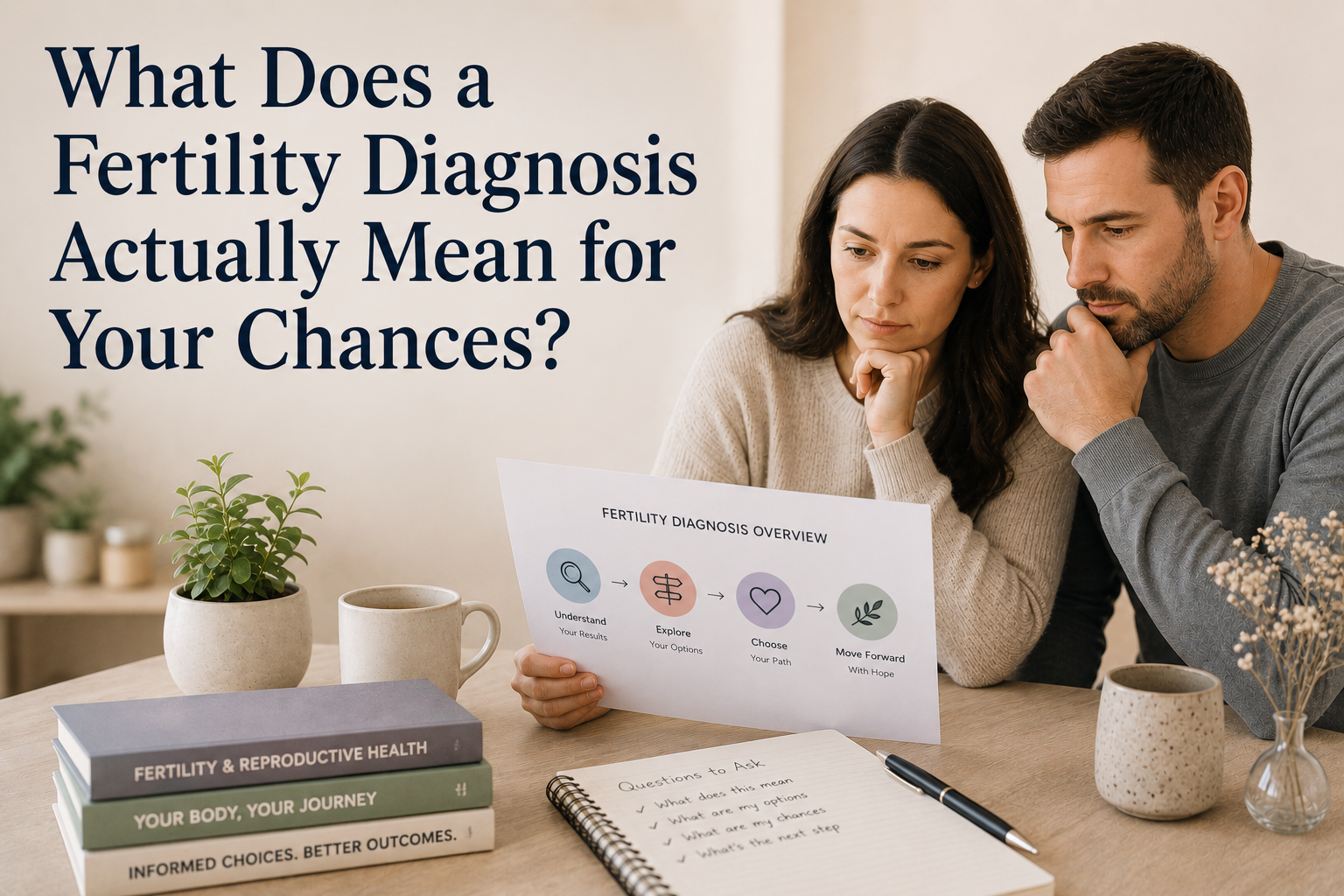
You went to the appointment. You waited for the results. And now you have words — possibly scary ones. Low AMH. Blocked tubes. Poor morphology. Unexplained infertility. PCOS. Endometriosis.
The words feel heavy. They can feel like a verdict.
They’re not. A fertility diagnosis is a direction — a clinical finding that points toward the most appropriate pathway. What any diagnosis means for your individual chances depends on a dozen variables that no single result can capture.
Before reading further, if you haven’t yet had your tests, our guide to fertility test results: AMH, FSH, and AFC explains what each number means and what it can and cannot tell you.
| Fertility medicine is probabilistic. A diagnosis tells you something important about your starting position. It doesn’t determine your destination. |
Low Ovarian Reserve (Low AMH)
What it means
Low ovarian reserve — most commonly indicated by a low AMH level (below 1.0 ng/mL, especially below 0.5 ng/mL) and a low antral follicle count — means that the quantity of remaining eggs is reduced relative to what’s expected for your age. For a plain-language explanation of AMH ranges and what they mean, see our fertility test results guide.
What it does NOT mean
- It does not mean your eggs are of poor quality — quantity and quality are separate things
- It does not mean IVF won’t work — it means the expected egg yield per retrieval is lower
- It does not mean you cannot conceive naturally — women with very low AMH do conceive
| Low AMH in a 28-year-old is a very different clinical situation from low AMH in a 41-year-old. Age context is critical when interpreting this diagnosis. |
Treatment pathway
IVF with modified stimulation protocols is the most common approach. For women with very low reserve who are also older, or who have had multiple failed own-egg cycles, donor egg IVF may be discussed. For detailed IVF costs and what’s involved, see IVF in South Africa: the complete guide.
Polycystic Ovary Syndrome (PCOS)
What it means
PCOS is the most common cause of ovulatory dysfunction, affecting approximately 8–13% of women of reproductive age. If you’re not ovulating regularly, you’re not releasing eggs — which significantly reduces the opportunity for natural conception. For a detailed overview of PCOS and how it affects fertility, read the Fertility Solutions PCOS guide and top treatment options for PCOS.
The counter-intuitive finding
Women with PCOS typically have high AMH levels and high follicle counts — lots of follicles, but they don’t mature and release normally. This actually makes PCOS one of the more treatable fertility diagnoses: the eggs are usually there; they just need the right signals.
Treatment pathway and chances
Lifestyle modification, oral ovulation-induction medication (Letrozole is the current gold standard), IUI with ovulation induction, and IVF when other approaches haven’t succeeded. With appropriate treatment, the majority of women with PCOS can conceive. Cumulative IVF success rates for women with PCOS are broadly comparable to women without it of the same age.
Blocked or Damaged Fallopian Tubes (Tubal Factor)
What it means
The fallopian tubes are where natural fertilisation occurs. If one or both tubes are blocked, narrowed, or scarred — due to previous infection, endometriosis, or surgery — eggs cannot travel normally.
- Unilateral blockage (one tube): conception can still occur through the open tube
- Bilateral blockage (both tubes): natural conception is effectively impossible
Treatment pathway and chances
For bilateral tubal blockage, IVF is the most effective treatment — it bypasses the tubes entirely. With otherwise good parameters, IVF success rates for tubal factor alone are generally solid and broadly in line with age-appropriate averages. Hydrosalpinges (fluid-filled tubes) that open into the uterus reduce IVF implantation rates — surgical removal before IVF significantly improves outcomes.
Endometriosis
What it means
Endometriosis is a condition where tissue similar to the uterine lining grows outside the uterus — on the ovaries, fallopian tubes, bowel, and peritoneum. It affects approximately 10% of women of reproductive age and contributes to infertility through multiple mechanisms: distorted anatomy, inflammatory environment, impact on egg quality, and reduced implantation.
Treatment pathway and chances
For mild-moderate endometriosis, IUI or expectant management may be appropriate depending on age and other factors. IVF is recommended for more severe disease. IVF success with mild endometriosis is broadly comparable to age-matched women without it. Experienced specialists with endo-specific protocols can significantly mitigate the impact of severe endometriosis on IVF outcomes — see our clinic directory for Aevitas Fertility Clinic, which specialises in endometriosis.
Unexplained Infertility
What it means
Unexplained infertility is diagnosed when a full investigation returns within normal parameters, but conception hasn’t occurred within the expected timeframe. If you haven’t yet had a complete workup, see our first fertility consultation guide for what tests should be included.
The frustration
The absence of an explanation does not mean the absence of a problem — it means current investigation hasn’t identified it yet. Many patients describe unexplained infertility as harder to sit with than a clear diagnosis, precisely because there is no identifiable problem to fix.
Treatment pathway and chances
For younger women, 3–4 IUI cycles with ovarian stimulation is typically first-line. IVF is recommended if unsuccessful, or for older women. A full cost breakdown of the unexplained infertility treatment pathway is in our cost of treating unexplained infertility guide.
Severe Male Factor Infertility
What it means
Severe male factor — very low count, very poor motility, very high abnormal morphology, or azoospermia — means natural fertilisation is significantly reduced or effectively zero. For a complete breakdown of male factor causes, diagnosis, and treatment, see our complete male fertility guide.
Treatment pathway and chances
ICSI (intracytoplasmic sperm injection) is the treatment of choice — a single sperm is selected and injected directly into each egg. When the female partner’s investigation is normal, IVF with ICSI for male factor has success rates broadly comparable to IVF for other indications at the same age. Read more in our IUI vs IVF vs ICSI guide.
Recurrent Implantation Failure
What it means
Recurrent implantation failure (RIF) is diagnosed when multiple good-quality embryo transfers have not resulted in a clinical pregnancy. It warrants a specific and detailed investigation.
Investigation and treatment
Testing for RIF includes: uterine cavity assessment (hysteroscopy), thrombophilia screening, immune testing, endometrial receptivity testing (ERA), and embryo chromosomal assessment using PGT-A (Next Biosciences). Identifying and treating specific causes meaningfully improves outcomes.
People Also Ask
Q: What is the most common fertility diagnosis?
A: Ovulatory dysfunction (including PCOS) is the most common female fertility diagnosis, followed by tubal factor and unexplained infertility. Male factor — most commonly OAT syndrome — is a primary or contributing factor in approximately 40–50% of cases.
Q: Does a fertility diagnosis mean I can’t have children?
A: Rarely. The vast majority of fertility diagnoses have treatment pathways that meaningfully improve the chance of pregnancy. Even severe diagnoses — bilateral tubal blockage, severe male factor — have effective treatments.
Q: Can fertility diagnoses change over time?
A: Yes. Endometriosis can progress. Ovarian reserve declines with age. Male factor can improve with lifestyle changes or treatment. Regular review of your clinical picture is valuable if your treatment journey extends over time.
Q: What does unexplained infertility mean?
A: It means standard investigation hasn’t identified a specific cause. It does not mean there is no problem — it means current testing hasn’t found it. Treatment options still exist and are effective.
Practical Takeaways
- A fertility diagnosis is a direction, not a verdict — it tells you where to start, not where you’ll end up
- Most common diagnoses have effective treatment pathways. Understanding yours helps you have better conversations with your specialist — see how to choose the right fertility clinic
- Age is almost always the most important modifier of prognosis — the same diagnosis has very different implications at 32 than at 40. See our fertility by age guide
- If your diagnosis feels overwhelming, a fertility concierge can help you interpret results in context and prepare for the decisions ahead
Disclaimer: This content is for educational purposes only and does not constitute medical advice. Always consult with a qualified healthcare provider before making decisions about fertility treatment.
About the Author
Leigh-Ann Geydien is the founder of Fertility Solutions, South Africa’s only dedicated fertility directory. With a deep commitment to patient advocacy, she built the platform to bridge the gap between those navigating fertility challenges and the clinics and reproductive health specialists best placed to help them.