You spent months — maybe years — trying. The injections, the waiting, the losses, the false starts. And then, finally, the result you’d been fighting for: a positive pregnancy test.
It’s supposed to feel like relief. Like celebration. Like the ending of one story and the beginning of another.
And sometimes it does. But for many people who have been through infertility treatment, pregnancy doesn’t arrive with the uncomplicated joy they’d imagined. Instead it arrives with something more complicated: fear, hypervigilance, grief for those who didn’t get here, guilt about feeling anything other than grateful, and the strange disorientation of not quite knowing how to be pregnant after everything it took to get there.
This guide is for you, wherever you are in that landscape.
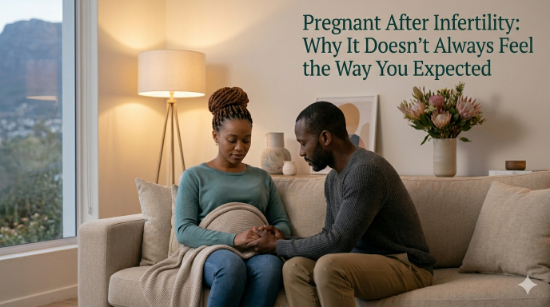
There is no correct way to feel after a positive pregnancy test following infertility. Whatever you’re experiencing — joy, terror, numbness, disbelief, or all of these at once — is a legitimate response to an experience that has been genuinely hard.
The Emotional Landscape of Pregnancy After Infertility
Fear of loss
For many people who have been through infertility treatment — particularly those who have experienced miscarriage, failed transfers, or multiple negative cycles — fear of loss is the dominant emotional experience of early pregnancy. The positive test is not a finish line; it feels like the beginning of a new kind of waiting. Our two-week wait guide describes the hypervigilance that characterises this phase — and for many, it doesn’t fully lift after the positive result.
This fear is not irrational. It is a calibrated response to genuine past experience of loss. The body and mind have learned, through repeated disappointment, to protect themselves from hope. That protection doesn’t just switch off because the circumstances have changed.
Hypervigilance — scanning your body constantly
If you found yourself symptom-checking hourly during the two-week wait, pregnancy after infertility can feel like an extended version of that experience. Every cramp analysed. Every change in symptom noted. Every day between scans felt in the body like a risk. This is not a sign that something is wrong with you — it is a normal psychological adaptation to a history of uncertainty.
The scan-to-scan experience
Many people who have been through infertility describe pregnancy as a series of two-week waits — from positive test to first scan, from first scan to heartbeat, from heartbeat to twelve weeks, from twelve weeks to anatomy scan. The relief of each milestone is real, but brief. Our guide to scan anxiety during fertility treatment covers specific strategies for managing the space between milestones.
Grief alongside joy
For many people, pregnancy after infertility coexists with unresolved grief — for the embryos that didn’t implant, the cycles that failed, the months and years that were spent in treatment rather than in the carefreeness of an uncomplicated conception. These losses don’t disappear because you’re pregnant. And sometimes the pregnancy itself makes them more present.
Grief for others still waiting
If you are part of an infertility community — online or in person — pregnancy can bring a complex mix of gratitude and guilt. The awareness that others are still in the place you were is real, and the discomfort it brings is entirely understandable.
Disconnection from normal pregnancy
The standard pregnancy experience — telling people at eight weeks, registering with an antenatal class, pinning nursery ideas — can feel inaccessible or even threatening. Many people who have been through infertility describe a difficulty in inhabiting the role of ‘pregnant person’ in the way it’s culturally scripted, because the script doesn’t account for what it took to get there.
What Is Happening Psychologically?
Research consistently shows that pregnancy after infertility carries elevated rates of anxiety, depression, and what some clinicians describe as posttraumatic stress symptoms — not because the pregnancy is going wrong, but because the history of infertility has genuinely been traumatic.
The key psychological process at work is called anxious attachment to pregnancy — a learned guardedness against hope, driven by past experience of loss. It is adaptive in the context where it developed. In pregnancy, it can make joy genuinely harder to access.
When anxiety becomes something that needs support
Normal levels of anxiety in pregnancy after infertility are expected and manageable. However, it’s worth seeking additional support if:
- Anxiety is constant and preventing sleep, eating, or normal daily functioning
- You are unable to feel any positive emotion about the pregnancy despite a clinically progressing one
- You are experiencing intrusive thoughts, flashbacks, or emotional numbness that goes beyond general worry
- Anxiety is significantly affecting your relationship with your partner
A psychologist who specialises in perinatal mental health — or a fertility counsellor with experience in pregnancy after infertility — is the appropriate support in these cases. A fertility concierge can help connect you with the right specialist.
Practical Strategies That Help
Allow yourself milestones, not the whole pregnancy at once
Many people find it helpful to commit to one milestone at a time — to allow themselves to invest, just a little, in each scan that shows good progress. Not all at once. Not nursery furniture at six weeks. But permission to celebrate the heartbeat when it’s confirmed. Permission to tell one person when you reach twelve weeks. Permission to gradually inhabit the pregnancy.
Name what you’re feeling to someone who understands
The experience of pregnancy after infertility is genuinely different from uncomplicated pregnancy, and most of the people around you — however kind — have not been through it. Finding someone who has is valuable: a fertility counsellor, a support group, an online community of people who get it.
Limit but don’t eliminate information-seeking
The impulse to track symptoms, research statistics, and check forums is understandable — it’s the same information-seeking behaviour that got you through treatment. But in pregnancy, unchecked, it can amplify rather than reduce anxiety. Setting a defined, limited window for symptom-checking (rather than attempting to stop entirely) tends to be more sustainable.
Talk to your midwife or obstetrician about your history
Many midwives and obstetricians are not routinely aware that pregnancy after infertility carries a distinct psychological profile. Telling your provider what you’ve been through, and what you need (more frequent reassurance scans, direct access for questions, acknowledgement of anxiety without dismissal), changes how you’re supported.
Your relationship with your partner
Infertility is hard on relationships. The dynamics built during treatment — who carried what emotional load, who was the ‘strong one’, who protected whom — don’t automatically restructure when a pregnancy begins. Some couples find pregnancy after infertility brings a new closeness. Others find they are processing the treatment years separately, in different emotional places. Both are normal. Couples counselling with someone who understands reproductive trauma can be a genuinely useful space.
Egg Donation and Pregnancy After Infertility
For those who conceived through egg donation, pregnancy after infertility brings an additional layer: the knowledge that the pregnancy is genetically the donor’s, and the ongoing process of understanding what that means for you and — eventually — for your child.
Research consistently shows that most egg donation recipients describe pregnancy as fully theirs — the physical experience of carrying the child, and the bond that forms through pregnancy, feels complete. But this doesn’t mean the genetic dimension disappears, and questions about disclosure, identity, and connection are real ones that deserve space and, where needed, professional support.
People Also Ask
Q: Is it normal to feel anxious after a positive IVF pregnancy test?
A: Extremely normal — and expected. Research shows elevated rates of anxiety and depression in pregnancy after infertility, reflecting the genuine psychological impact of the treatment experience. Anxiety does not mean something is going wrong; it means your history has given you reason to be cautious about hope.
Q: How do I enjoy pregnancy after infertility?
A: Gradually, and in milestones. Many people find that the anxiety doesn’t disappear, but reduces incrementally with each scan that shows good progress. Permission to feel cautious and hopeful simultaneously — rather than pressure to feel purely joyful — tends to allow more genuine positive emotion over time.
Q: When does pregnancy anxiety reduce after IVF?
A: For most people, anxiety is highest in the first trimester and reduces significantly after the anatomy scan (18–20 weeks) confirms normal fetal development. For some, anxiety persists throughout the pregnancy and into early parenthood. If anxiety is significantly affecting your quality of life, please seek support from a perinatal mental health specialist.
Q: Is it normal to feel grief during pregnancy after infertility?
A: Yes. Grief for embryos that didn’t implant, cycles that failed, months and years spent in treatment, and others still waiting — these losses don’t disappear because you’re pregnant. They can become more present. This is a normal and recognised part of the pregnancy-after-infertility experience.
Practical Takeaways
- There is no correct way to feel about pregnancy after infertility — joy, fear, grief, and disbelief can all coexist
- Hypervigilance and scan-to-scan anxiety are normal adaptive responses to a history of infertility — not signs that something is wrong
- Scan anxiety specifically is addressed in our guide to managing scan anxiety during fertility treatment
- If anxiety is significantly affecting your daily functioning or relationship, a perinatal psychologist or fertility counsellor is the appropriate support
- Gradual investment in the pregnancy — milestone by milestone — is a more sustainable approach than either full engagement or full guardedness
- A fertility concierge can help connect you with specialist psychological support appropriate for the pregnancy-after-infertility experience
Disclaimer: This article is for educational purposes only and does not constitute psychological or medical advice. If you are experiencing significant anxiety, depression, or distress during pregnancy, please seek support from a qualified perinatal mental health professional.
About the Author
Leigh-Ann Geydien is the founder of Fertility Solutions, South Africa’s only dedicated fertility directory. With a deep commitment to patient advocacy, she built the platform to bridge the gap between those navigating fertility challenges and the clinics and reproductive health specialists best placed to help them.