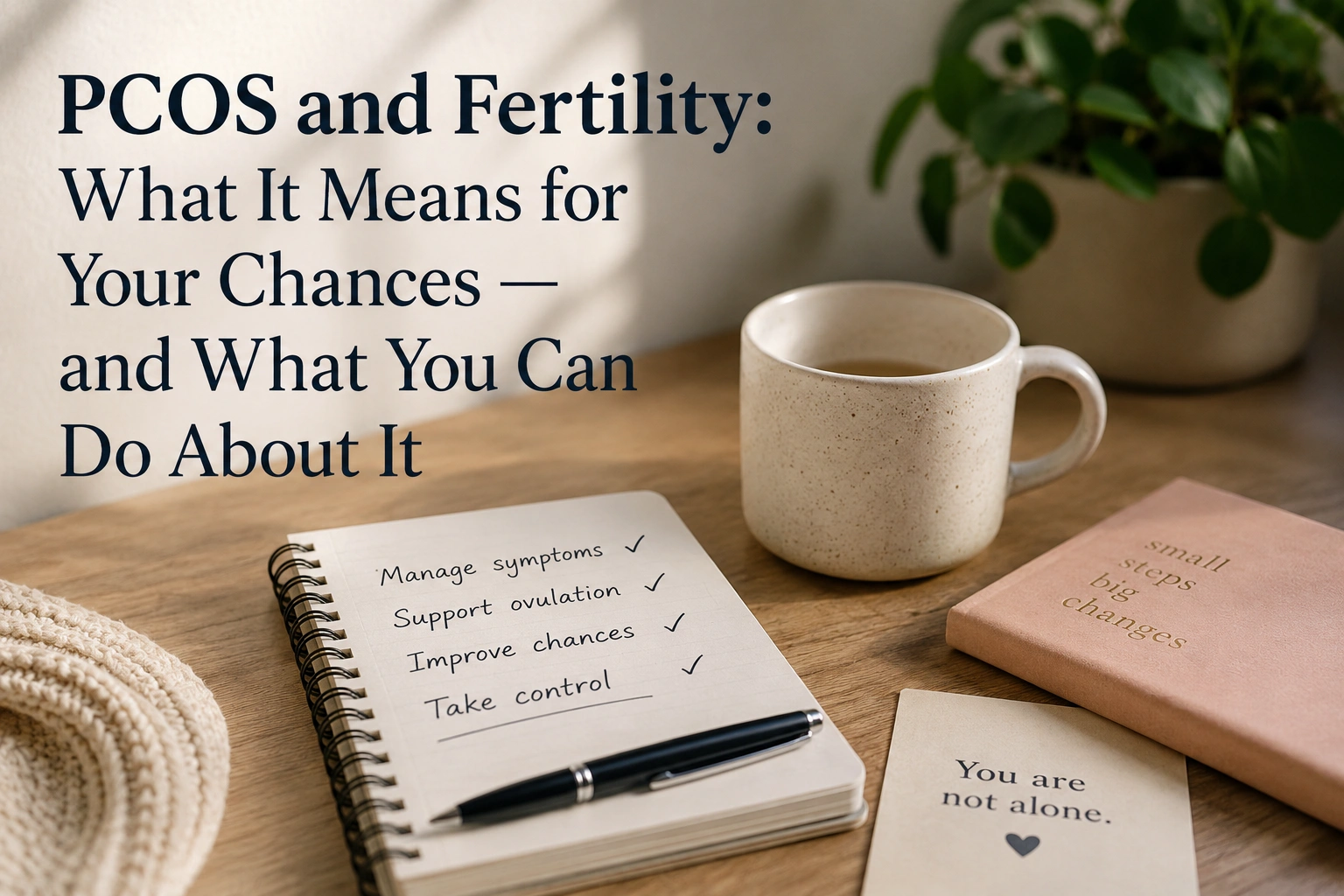
PCOS — polycystic ovary syndrome — is diagnosed in approximately 8–13% of women of reproductive age worldwide, making it the most common endocrine disorder in women and the most frequent cause of ovulatory infertility. If you have PCOS and you’re trying to conceive, you are not in a small, unusual situation. You are in the most well-researched category of female fertility challenge there is.
That matters — because it means there is a clear, evidence-based treatment pathway, and that the majority of women with PCOS who want to conceive do so. This guide explains what PCOS actually does to fertility, what treatment options exist, and what the realistic outlook is. For a broader overview of what a diagnosis means for your chances, see our fertility diagnosis guide.
What PCOS Does to Fertility
PCOS affects fertility primarily through its impact on ovulation. In a normal menstrual cycle, one dominant follicle develops, releases an egg, and the luteal phase prepares the uterine lining for potential implantation. In PCOS, this process is disrupted: multiple small follicles develop but none reaches dominance, ovulation is delayed, irregular, or absent, and the hormonal signals that govern the cycle are dysregulated.
The key hormonal features:
- Elevated LH relative to FSH — disrupts follicle development and ovulation timing
- Elevated androgens (testosterone, DHEAS) — suppress normal follicular development and affect egg quality
- Insulin resistance (in many, not all, cases) — drives androgen excess and contributes to ovulation failure
- High AMH — reflecting the large pool of small antral follicles characteristic of PCOS
| The paradox of PCOS: women with PCOS typically have high AMH and many follicles — suggesting good ovarian reserve. The challenge is not the number of eggs but the hormonal environment that prevents them from maturing and releasing normally. |
Does PCOS Affect Egg Quality?
This is a nuanced question. Research suggests that in PCOS, egg quality is generally not significantly impaired — particularly in younger women. The primary issue is the ovulatory dysfunction, not the eggs themselves. However:
- Elevated androgens can affect oocyte maturation and embryo quality in some cases
- Obesity — present in approximately 50–60% of women with PCOS — is independently associated with poorer egg quality and implantation rates
- In IVF, PCOS eggs generally fertilise and develop at normal rates when retrieved from a well-managed stimulation
Can Women with PCOS Conceive Naturally?
Yes — particularly those with irregular rather than absent ovulation. Women who ovulate infrequently (oligovulation) do have natural conception opportunities; they simply occur less frequently than in women with regular cycles. Tracking ovulation with LH tests or ultrasound monitoring gives PCOS patients the best chance of timing intercourse accurately.
Women with PCOS who have completely absent ovulation (anovulation) need medical intervention to conceive. The six-month window guide explains when to seek help — for PCOS with irregular cycles, earlier assessment is recommended rather than waiting the standard 12 months.
Treatment Pathways — A Clear Progression
Step 1: Lifestyle modification
For overweight women with PCOS, weight loss of 5–10% of body weight is the single most effective first-line intervention for restoring ovulation. Even modest weight loss significantly improves hormonal profiles, restores spontaneous ovulation in many women, and improves response to subsequent medication. This is not about aesthetics — it is about insulin sensitisation and androgen reduction.
Diet approaches specifically supported for PCOS: low glycaemic index eating, reduced refined carbohydrates, adequate protein. Supplementation evidence is covered in our PCOS supplements guide.
Step 2: Ovulation induction — Letrozole (first-line)
Letrozole (an aromatase inhibitor, originally developed as a breast cancer medication) is now the evidence-based first-line ovulation induction agent for PCOS, having superseded Clomiphene Citrate in most guidelines. It works by temporarily lowering oestrogen, prompting FSH release and follicle development.
- Taken orally on Days 2–6 of the cycle (or triggered cycle)
- Ovulation rate approximately 70–80% per cycle in PCOS
- Cumulative live birth rates of 27–32% over 6 cycles (NEJM, 2014 landmark PPCOS trial)
- Lower multiple pregnancy rate than Clomiphene — typically monofollicular
Letrozole cycles are monitored with ultrasound to confirm follicle development and time intercourse or IUI. For the comparison between Letrozole cycles + IUI vs moving to IVF, see our IUI vs IVF vs ICSI guide.
Step 3: Clomiphene Citrate (second-line oral)
Clomiphene remains an option where Letrozole is unavailable or contraindicated. Ovulation rates are comparable, but multiple pregnancy rates are higher and some studies suggest modestly lower pregnancy rates in PCOS specifically.
Step 4: Injectable gonadotrophins
Where oral ovulation induction has not achieved conception, low-dose FSH injections provide more precise follicular control. These cycles require careful monitoring to reduce multiple pregnancy risk in PCOS patients, who are very sensitive to gonadotrophins.
Step 5: IVF
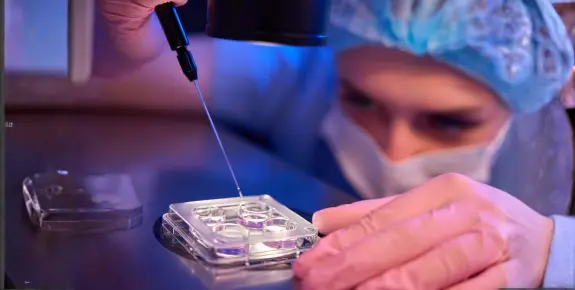
IVF is recommended for PCOS when ovulation induction has not resulted in pregnancy after 3–6 cycles, when there are additional fertility factors (tubal, male factor), or when the patient is older and time matters. PCOS patients often respond very strongly to IVF stimulation — producing many eggs — which paradoxically increases the risk of OHSS. See our OHSS guide for what this means and how it’s managed.
Success rates for IVF in PCOS are broadly comparable to age-matched women without PCOS — the issue in PCOS is primarily ovulation, not embryo quality or implantation when the cycle is well-managed.
| Treatment | Ovulation Rate | Pregnancy Rate per Cycle | Notes |
| Letrozole (oral) | 70–80% | 15–25% | First-line; low multiple risk |
| Clomiphene (oral) | 65–75% | 12–22% | Second-line; higher multiple rate |
| Low-dose FSH injections | 75–85% | 15–25% | Requires close monitoring |
| IUI + ovulation induction | — | 10–20% | Combined; useful for couples |
| IVF | — | 35–55% (age-dependent) | Reserved for failed prior steps |
PCOS and IVF — What to Know
OHSS risk
Women with PCOS are at significantly higher risk of ovarian hyperstimulation syndrome (OHSS) in IVF — because they have many follicles that can all respond simultaneously to stimulation. Modern IVF protocols manage this through: antagonist protocols, GnRH agonist trigger instead of hCG, freeze-all strategies (no fresh transfer in at-risk cycles), and careful dose titration. Read our OHSS guide for the full picture on symptoms and management.
Freeze-all strategy
In PCOS patients at OHSS risk, the freeze-all approach — retrieving and freezing all embryos, then doing a frozen embryo transfer in a subsequent natural or medicated cycle — is now standard at quality SA clinics. It eliminates fresh transfer OHSS risk entirely and, in PCOS, often produces comparable or better outcomes than fresh transfer.
Metformin in IVF
Metformin (an insulin-sensitising medication used in type 2 diabetes) is commonly prescribed alongside IVF protocols for PCOS patients, particularly those with insulin resistance. Evidence supports its use in reducing OHSS risk and improving cycle outcomes in this group.
Myths vs Facts — PCOS and Fertility
Myth: PCOS means I can’t get pregnant.
Fact: PCOS is the most treatable cause of female infertility. The majority of women with PCOS who want to conceive do so, most within a few treatment cycles.
Myth: I have to lose weight before treatment will work.
Fact: Weight loss significantly improves outcomes in overweight women with PCOS, but treatment can be offered concurrently. The evidence supports lifestyle modification as first-line — it does not mean treatment must wait indefinitely for a weight target to be reached.
Myth: My high AMH means I have better fertility than other women.
Fact: High AMH in PCOS reflects the number of small, arrested follicles — not a functional advantage. Women with PCOS have many follicles but a dysfunctional hormonal environment that prevents normal ovulation.
Myth: IVF is the only option for PCOS.
Fact: IVF is typically the last resort, not the first. Most women with PCOS conceive through lifestyle changes, oral ovulation induction, or IUI before IVF is considered.
People Also Ask
Q: Can I get pregnant naturally with PCOS?
A: Yes — particularly if you have irregular rather than absent ovulation. Tracking ovulation precisely with LH tests or ultrasound monitoring maximises your natural conception opportunities. Women with complete anovulation need medical ovulation induction but can still conceive without IVF in most cases.
Q: What is the best fertility treatment for PCOS?
A: The evidence-based first-line treatment is Letrozole for ovulation induction, with lifestyle modification (particularly weight loss in overweight women) as a concurrent intervention. IVF is reserved for cases where simpler treatments have not succeeded or where additional factors are present.
Q: Does PCOS affect IVF success rates?
A: Not significantly when the cycle is well-managed. PCOS patients typically respond strongly to stimulation (sometimes too strongly, raising OHSS risk), but egg quality and implantation rates are broadly comparable to age-matched women without PCOS when OHSS risk is appropriately managed.
Q: How long does it take to get pregnant with PCOS?
A: This depends on the treatment pathway. Letrozole ovulation induction cycles: cumulative pregnancy rates of 27–32% over 6 cycles in research settings. With IVF, most PCOS patients who are good candidates achieve pregnancy within 2–3 cycles. Timeline varies significantly by age, BMI, and other factors.
Practical Takeaways
- PCOS is the most common and most treatable cause of ovulatory infertility — most women with PCOS do conceive
- Lifestyle modification — particularly weight loss in overweight women — is genuinely the most powerful first-line intervention. See our fertility nutrition guide for evidence-based dietary approaches
- Letrozole is the first-line medication — not Clomiphene. If you’ve been offered Clomiphene as the first step, it’s worth asking whether Letrozole is appropriate for your case
- OHSS is a genuine risk in PCOS IVF cycles — ensure your clinic has a clear protocol for managing it, including freeze-all when indicated. See our OHSS guide
- For further PCOS-specific resources, see the Fertility Solutions PCOS page, top treatment options for PCOS, and supplements guide for PCOS
| → Read more: Top Treatment Options for PCOS — Fertility Solutions |
This article is for educational purposes only and does not constitute medical advice. All treatment decisions should be made in consultation with a qualified reproductive medicine specialist.