For Muslim couples facing fertility challenges, the medical questions about treatment options are inseparable from a deeper set of questions: Is this permissible? What do the scholars say? How do I pursue treatment without compromising my faith?
These questions are serious ones, and they deserve serious engagement. This article does not offer religious rulings — that is the role of qualified Islamic scholars, not a fertility platform. What it offers is a careful summary of the main scholarly positions that have been developed on assisted reproduction, the areas of consensus and disagreement among Muslim jurists, and the practical framework that allows most Muslim couples to pursue treatment that is theologically considered and medically effective.
| This article presents scholarly opinions for educational purposes. Individual Muslims are encouraged to consult with a qualified Islamic scholar or institution they trust when making decisions about fertility treatment. Different schools of thought and different scholars hold different positions on the specific questions involved. |
The Foundation: Islam’s View of Children and Procreation
Islam places high value on procreation and the continuation of lineage (nasab). Children are considered an amanah (trust) from Allah, and the desire for children is understood as a legitimate and valued human aspiration. Seeking treatment for a medical condition that prevents conception is therefore, in itself, an act consistent with Islamic principles — the seeking of a cure (al-tadawwi) is encouraged in the Hadith.
The Prophetic tradition includes the instruction: “Seek treatment, O servants of Allah, for Allah has not created a disease without creating a cure” (Abu Dawud). This hadith provides the foundational basis for pursuing medical fertility treatment within Islam.
IUI — Intrauterine Insemination
The scholarly consensus on IUI is the most straightforward of the fertility treatments. Where IUI uses the husband’s own sperm, inseminated into his wife’s uterus, it is widely considered permissible (halal) across all major scholarly bodies and schools of thought. The Fiqh Academy of the Muslim World League, the Islamic Fiqh Academy of the OIC, and most individual scholars who have addressed the question affirm this position.
The key principle: any fertility treatment that assists the husband’s sperm to fertilise the wife’s egg, within a valid marriage, without the introduction of any third party genetic material, is generally considered permissible in Islamic jurisprudence.
IUI with donor sperm — from a man other than the husband — is considered impermissible by the scholarly consensus, as it introduces third-party genetic material in a manner that Islamic jurisprudence considers to violate the principle of nasab (lineage). Muslim couples using donor sperm must understand this scholarly position clearly before proceeding.
IVF — In Vitro Fertilisation
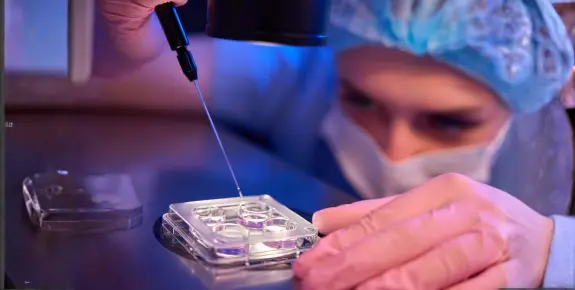
IVF using the husband’s sperm and the wife’s egg — with no third-party genetic material involved — is considered permissible by the major Islamic scholarly bodies, including the Islamic Fiqh Academy (Mecca, 1984), the Islamic Medical Association of North America, and most contemporary Muslim scholars who have addressed the question. The key conditions are:
- The sperm must be from the husband and the egg from the wife
- The uterus carrying the pregnancy must be the wife’s own uterus
- The marriage must be valid and ongoing at the time of treatment
- Extra embryos should be treated with respect — the scholarly positions on what may be done with surplus embryos vary and should be discussed with a qualified scholar
ICSI — the injection of a single sperm directly into an egg — is considered permissible under the same conditions, as it remains a procedure involving only the husband’s sperm and the wife’s egg. For a detailed explanation of the medical procedure, see our IUI vs IVF vs ICSI guide.
Egg Donation — The More Complex Question
Egg donation — where an egg from a third party (a donor) is used — is a significantly more contested question in Islamic jurisprudence, and one where the scholarly community is genuinely divided. This division is not a sign of confusion but of genuine engagement with a genuinely difficult question. The key debate centres on:
The prohibition position
A significant body of scholarly opinion holds that egg donation is not permissible, on the basis that introducing a third party’s genetic material — even through egg donation rather than sexual intercourse — introduces confusion into lineage (ikhtilat al-ansab), which Islam considers a serious violation. This position is held by the Islamic Fiqh Academy of the OIC and by many scholars in the Arab Gulf states.
The permissibility position
A different body of scholarly opinion — particularly, though not exclusively, from South Asian and some Egyptian scholars — holds that egg donation within certain strict conditions may be permissible, drawing on analogies to permitted medical procedures and arguing that the prohibition on ikhtilat al-ansab applies to sexual intercourse, not to medical procedures. This position is a minority view but is held by respected scholars and is the basis on which some Muslim couples in certain jurisdictions pursue egg donation with scholarly guidance. Egg donation in South Africa is legally available and widely practised — but Muslim couples should obtain individual scholarly guidance before proceeding, given the genuine diversity of scholarly opinion.
Surrogacy — The Clearest Prohibition
Surrogacy — where another woman carries the pregnancy — is considered impermissible by the overwhelming majority of Islamic scholars across all schools of thought. The prohibition is based on: the violation of the sanctity of the marital relationship (the woman carrying the child is not the wife), the introduction of lineage confusion, and the potential exploitation of the surrogate.
This is the area of greatest scholarly consensus among the contested questions in assisted reproduction within Islam. Muslim couples considering surrogacy for medical reasons — where carrying a pregnancy is impossible — are advised to seek extensive scholarly guidance before proceeding.
Surplus Embryos — A Question That Requires Advance Planning
IVF frequently produces more embryos than are transferred in a single cycle. The question of what may be done with surplus (frozen) embryos is one that Muslim couples should address before starting IVF, not after. The main scholarly positions on surplus embryos include:
- Transferring all viable embryos in subsequent cycles (most widely endorsed)
- Donating surplus embryos to research (contested — opinions vary by scholarly tradition)
- Discarding surplus embryos after a defined period (contested — some scholars consider this permissible; others consider early embryos to have a sanctified status that prohibits destruction)
Having this conversation with both your fertility specialist and a qualified Islamic scholar before treatment begins allows you to plan a protocol that aligns with your theological position — for example, fertilising only as many eggs as you intend to use in a given cycle.
Practical Guidance for Muslim Couples Seeking Fertility Treatment
Consult a qualified scholar before treatment
The scholarly positions summarised here are starting points for understanding, not fatwas to act on. Consulting a qualified Islamic scholar — particularly one who has knowledge of medical ethics and assisted reproduction — before beginning treatment is the most important step a Muslim couple can take. In South Africa, the Muslim Judicial Council and the Jamiatul Ulama are resources for scholarly guidance. Internationally, the Islamic Medical Association and various fiqh academies publish guidance on assisted reproduction.
Have the embryo question resolved before stimulation
Don’t begin an IVF cycle without having clarity on your theological position regarding surplus embryos. This affects protocol decisions — including how many eggs to fertilise — and having this clarity before retrieval prevents a difficult decision being made under time pressure.
Choose a clinic experienced in working with Muslim patients
Most major South African fertility clinics have experience treating Muslim patients and can accommodate specific requirements — including timing treatment around Ramadan, adapting protocols for patients who wish to minimise surplus embryos, and providing private consultation spaces. Discuss your specific requirements directly with your chosen clinic. For choosing the right South African clinic, our guide covers the key questions to ask.
Give yourself permission to grieve and seek support
The intersection of infertility and religious obligation carries a particular weight — the sense that failing to conceive is a spiritual failure as well as a medical one. This is theologically incorrect (infertility is a medical condition, not a divine punishment), but the feeling is real and deserves support rather than dismissal. Our guide on the weight of family and cultural pressure in infertility addresses this dimension in more depth.
People Also Ask
Q: Is IVF halal in Islam?
A: IVF using the husband’s sperm and the wife’s egg, with no third-party genetic material, within a valid and ongoing marriage, is considered permissible by the major Islamic scholarly bodies, including the Islamic Fiqh Academy. Conditions apply regarding the handling of surplus embryos — consult a qualified scholar before beginning treatment.
Q: Is egg donation allowed in Islam?
A: Egg donation is a genuinely contested question in Islamic jurisprudence, with a significant body of scholarly opinion considering it impermissible (due to the introduction of third-party genetic material affecting lineage) and a minority position permitting it under strict conditions. Muslim couples considering egg donation should obtain individual scholarly guidance from a qualified Islamic scholar before proceeding.
Q: Is donor sperm allowed in Islam?
A: The use of donor sperm from a man other than the husband is considered impermissible by the scholarly consensus across all major schools of thought, on the basis that it violates the Islamic principle of lineage (nasab).
Q: What should Muslim couples do with frozen embryos?
A: This is a theologically contested question with different scholarly positions. It is strongly advisable to consult a qualified Islamic scholar before beginning IVF to determine your theological position and allow the clinic to plan a protocol accordingly — for example, fertilising only as many eggs as you intend to use.
Practical Takeaways
- IVF and IUI using only the husband’s sperm and wife’s egg, within a valid marriage, is considered permissible by the major Islamic scholarly bodies
- Donor sperm is considered impermissible by scholarly consensus; egg donation is genuinely contested — individual scholarly guidance is essential before proceeding
- Surrogacy is considered impermissible by the overwhelming majority of scholars
- The surplus embryo question should be resolved before beginning IVF, not after — it affects protocol planning
- South African fertility clinics are experienced in working with Muslim patients — discuss your specific requirements directly. A fertility concierge can help identify the right clinic and navigate the process within your theological framework
Disclaimer: This article is for educational purposes only and presents scholarly opinions for informational use. It does not constitute a fatwa or religious ruling. Muslims are encouraged to consult a qualified Islamic scholar for individual guidance on decisions relating to fertility treatment. Medical information reviewed for accuracy against current SASREG guidelines.
About the Author
Leigh-Ann Geydien is the founder of Fertility Solutions, South Africa’s only dedicated fertility directory. With a deep commitment to patient advocacy, she built the platform to bridge the gap between those navigating fertility challenges and the clinics and reproductive health specialists best placed to help them.