
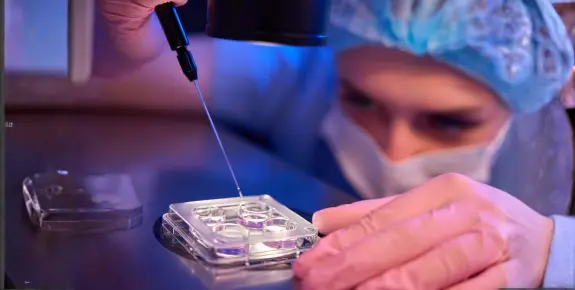
Somewhere in a laboratory right now, under a microscope powerful enough to resolve a single cell, an embryologist could be making a decision that changes your family forever.
They work in near-silence, in a carefully controlled environment where temperature, pH, and humidity are monitored to decimal-point precision. In front of them, suspended in a drop of culture medium, is a human blastocyst – a five-day-old embryo roughly the size of a grain of sand. And they are about to take a biopsy.
Who Are Embryologists?
An embryologist is a specialist scientist who works in the IVF laboratory, caring for your eggs, sperm, and embryos at every stage outside the body. Their work begins before fertilisation and continues until the moment your embryo is transferred into the uterus, or frozen for future use.
It is painstaking, high-stakes, highly skilled work – much of it happening behind closed laboratory doors while you wait at home, hope and anxiety in equal measure.
The IVF Laboratory: A Carefully Controlled World
The IVF lab is one of the most controlled environments in medicine. Human embryos are extraordinarily sensitive – small fluctuations in temperature, light exposure, or gas composition can affect development. It is also where one of the most significant advances in reproductive medicine takes place: the embryo biopsy.
What is Embryo Biopsy, and Is It Safe for My Embryo?
Embryo biopsy is the procedure that makes Preimplantation Genetic Testing (PGT) possible. It involves removing a small number of cells from your developing embryo so that its DNA can be analysed – without harming its ability to develop into a healthy baby.
The technique has evolved significantly over the past three decades. Today, the preferred approach is trophectoderm biopsy (the outer layer that will become the placenta, not the baby) at the blastocyst stage (Day 5 or 6 of development). The embryologist uses a laser to gently open the zona pellucida (the outer shell of the embryo), then a fine glass pipette to carefully remove 5-10 trophectoderm cells.
These cells are then sent to the genetics laboratory at Next Biosciences for analysis. Your embryo is frozen immediately – a process called vitrification – and kept safely at your clinic while you await results.
From Biopsy to Result: How PGT-A Works
Once your embryo’s biopsied cells arrive in our genetics laboratory, the DNA is extracted, amplified, and analysed using Next Generation Sequencing (NGS).
PGT-A (Preimplantation Genetic Testing for Aneuploidies) examines all 23 pairs of chromosomes in the biopsied cells, checking for extra or missing chromosomes – a state called aneuploidy.
Chromosomal aneuploidy is the single most common cause of:
- Failed embryo implantation
- First-trimester miscarriage
- IVF cycle failure
The likelihood of aneuploidy increases significantly with maternal age. Research published in Fertility and Sterility found that in women under 35, approximately 40% of blastocysts may be aneuploid – rising to over 80% in women over 40.¹
PGT-A identifies which of your embryos are euploid (chromosomally normal), giving your fertility team the information to prioritise these for transfer. The impact on outcomes is clinically significant:
- Increased live birth rates per transfer
- Reduced miscarriage rates
- Fewer IVF cycles needed to achieve a successful pregnancy
- Shorter time to pregnancy
Behind Every Result: A Human Story
It is easy to describe PGT-A in clinical terms – chromosomes, sequencing, euploid, aneuploid. But behind every result is a person, or a couple, who has been through something profoundly difficult to get to this point.
Perhaps you’ve had three IVF cycles, each ending in a negative test. Perhaps you lost a pregnancy at 18 weeks to a chromosomal condition you did not know was in your family. Perhaps you’re 42, know your time is limited, and want to give yourself every possible chance.
For you, PGT-A is not an abstract technology. It is hope, made visible.
To learn more about Preimplantation Genetic Testing at Next Biosciences, visit nextbio.co.za or contact our team on 011 697 2900 or genetics@nextbio.co.za. Our in-house genetic counsellor is available to guide you through your options.
References
- Franasiak JM, Forman EJ, Hong KH, et al. The nature of aneuploidy with increasing age of the human egg: a review of 15,169 consecutive trophectoderm biopsies evaluated with comprehensive chromosomal screening. Fertility and Sterility. 2014;101(3):656–663.