The fertility nutrition space is one of the most aggressively marketed areas of health advice — and one of the most poorly regulated. For every claim backed by genuine research, there are dozens backed by supplement industry funding, extrapolated from animal studies, or simply invented.
This guide tells you what the actual evidence shows. Not what sells supplements. Not what fertility influencers recommend. What peer-reviewed research, systematic reviews, and the clinical guidelines of major reproductive medicine bodies say about diet, nutrition, and fertility outcomes.
| The honest starting position: no dietary intervention has been proven to restore ovarian reserve, fix blocked tubes, or cure severe male factor infertility. Nutrition influences the hormonal environment, egg and sperm quality at the margins, and general reproductive health — it is a supporting factor, not a primary treatment. What it can do is real and meaningful. But it works alongside medical assessment and treatment, not instead of it. |
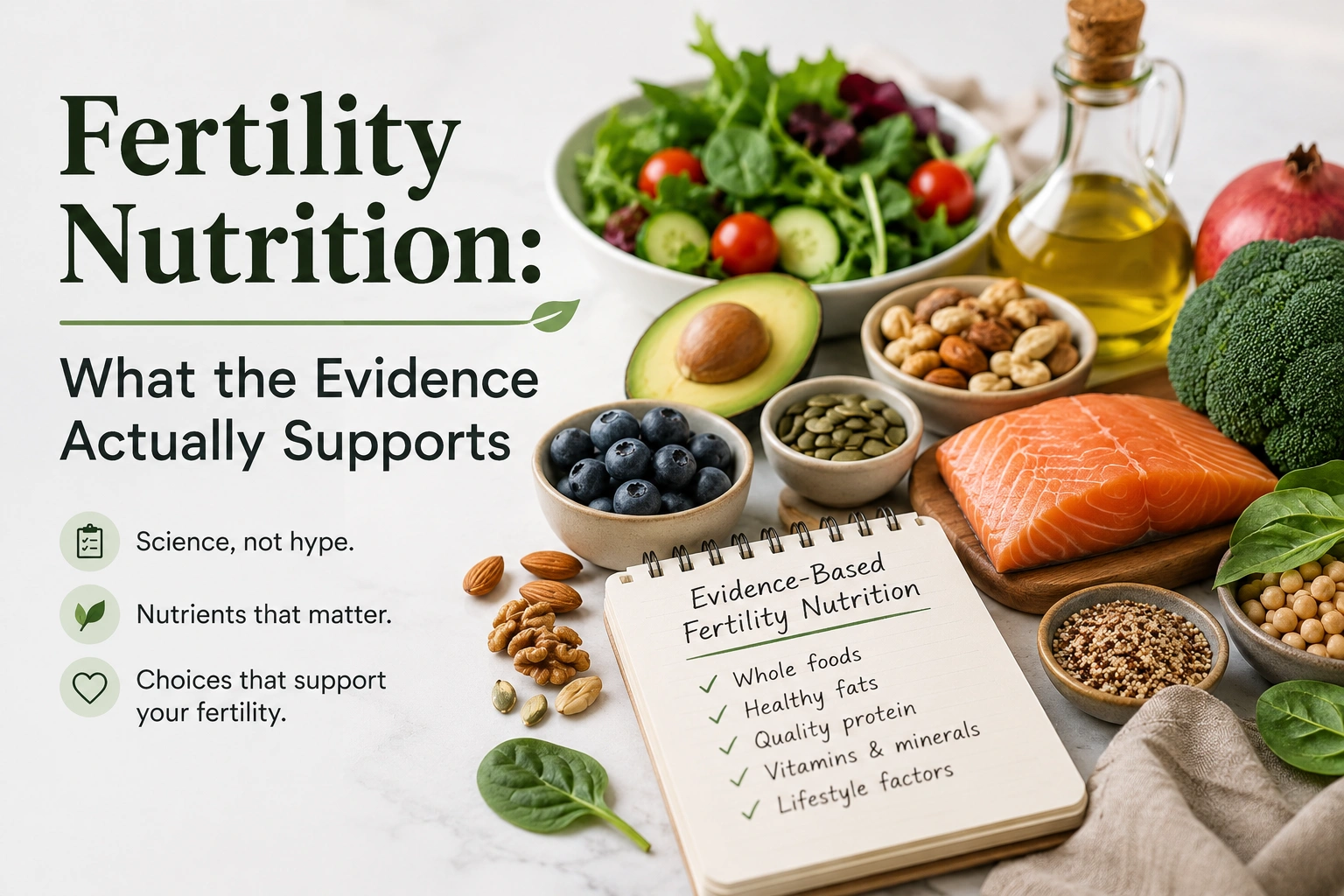
The Best-Evidenced Overall Pattern: The Mediterranean Diet
The most consistently supported dietary pattern for fertility — for both female and male reproductive health — is the Mediterranean dietary pattern. This is not a specific diet programme; it is a broad pattern of eating characterised by:
- High intake of vegetables, legumes, fruits, whole grains, nuts, and seeds
- Olive oil as the primary fat source
- Moderate fish and seafood consumption
- Low-to-moderate dairy and poultry
- Low red meat and processed meat
- Low refined carbohydrates and added sugar
Research supporting this pattern for fertility:
- A prospective cohort study (Gaskins et al., Human Reproduction, 2019) found that women whose diets most closely resembled the Mediterranean pattern had a 44% higher probability of achieving pregnancy through IVF
- A meta-analysis (Karayiannis et al., 2017) found Mediterranean diet adherence significantly associated with higher IVF success rates
- Multiple studies link Mediterranean pattern eating with improved sperm quality parameters — count, motility, and morphology
The Mediterranean pattern is also specifically recommended in PCOS management for its insulin-sensitising effects, and in endometriosis management for its anti-inflammatory properties.
Key Nutrients with Evidence for Fertility
Folate / Folic Acid
The evidence for folate in preventing neural tube defects is beyond question — this is why folic acid supplementation (400–800 mcg daily, or 5mg for higher-risk women) is recommended from preconception. Its role in broader fertility outcomes is less certain but biologically plausible through its role in DNA synthesis and methylation. Start supplementation at least 3 months before you begin trying.
Omega-3 Fatty Acids (DHA/EPA)
Omega-3 fatty acids — found in oily fish (salmon, sardines, mackerel), walnuts, and flaxseed — have the strongest evidence of any specific nutrient for male fertility. Research shows omega-3 supplementation (specifically DHA) improves sperm count, motility, and morphology in men with deficient parameters. In women, omega-3s may support ovarian function and reduce inflammation (relevant for endometriosis and PCOS). Recommended: 2 portions of oily fish per week, or 1–2g DHA/EPA supplement daily.
CoQ10 (Coenzyme Q10)
CoQ10 is an antioxidant produced naturally in the body, concentrated in cells with high energy demands — including eggs and sperm. Levels decline with age. Research on CoQ10 supplementation:
- For women: small randomised trials suggest improved ovarian response and embryo quality in poor responders, particularly women over 35. Evidence is promising but not conclusive.
- For men: multiple randomised trials show improved sperm motility and morphology with CoQ10 supplementation (200–600mg daily)
CoQ10 is one of the more evidence-supported supplements in fertility, though effect sizes are modest. It is safe and well-tolerated.
Vitamin D
Vitamin D deficiency is common in South Africa despite sun exposure (particularly in office workers and darker-skinned individuals), and is associated with poorer IVF outcomes and increased miscarriage risk. Research is observational rather than interventional, but optimising vitamin D status before IVF is a low-risk, low-cost recommendation. Testing serum 25-OH Vitamin D and supplementing to reach 75–100 nmol/L is appropriate.
Zinc (for men)
Zinc is essential for sperm production and testosterone synthesis. Deficiency is associated with reduced sperm count and increased DNA fragmentation. Combined zinc and folate supplementation has evidence for improving sperm parameters in subfertile men. Dose: 25–66mg zinc daily, in combination with folate.
Antioxidants generally
Oxidative stress — damage from free radicals — impairs both egg and sperm quality. A diet high in antioxidant-rich foods (colourful vegetables and fruits, nuts, seeds, olive oil) reduces oxidative stress. Specific antioxidant supplements (Vitamin C, Vitamin E, Selenium) have modest evidence for male fertility; the dietary pattern approach has stronger evidence than isolated supplementation.
Foods and Factors That Harm Fertility
Ultra-processed foods
Consistently associated in large epidemiological studies with poorer fertility outcomes in both sexes. The mechanism is likely multiple: insulin dysregulation, oxidative stress, hormonal disruption from additives and plasticisers, and displacement of nutrient-dense foods. The single most impactful dietary change for most people: reducing ultra-processed food consumption.
Trans fats
A large prospective study (Chavarro et al., American Journal of Clinical Nutrition, 2007) found that each 2% increase in trans fat energy intake was associated with a 73% higher risk of ovulatory infertility. Trans fats are found in hydrogenated vegetable oils, many processed baked goods, and fried fast food.
Excess alcohol
Associated with reduced fertility in both sexes. For women: alcohol reduces ovarian reserve markers and disrupts ovulatory function; for men: reduces testosterone, impairs sperm production, and increases abnormal morphology. The reproductive medicine consensus is that alcohol should be minimised during fertility treatment cycles and ideally eliminated in the month before an IVF cycle.
Smoking
One of the most clearly documented lifestyle fertility harms. In women: smoking is associated with reduced ovarian reserve, earlier menopause, and significantly lower IVF success rates. In men: reduces count, motility, and morphology; significantly increases sperm DNA fragmentation. If you smoke, stopping is the highest-impact single lifestyle change you can make for your fertility.
Excess caffeine
The evidence on caffeine and fertility is mixed. Most guidelines recommend limiting caffeine to under 200mg/day (approximately one cup of filter coffee) during active fertility treatment and pregnancy. High caffeine intake (>300mg/day) is associated with modestly increased miscarriage risk in some studies.
Endocrine disruptors
Chemicals that mimic or interfere with hormones — found in certain plastics (BPA), pesticides, personal care products, and non-stick cookware — are a legitimate concern in reproductive health. The evidence is strongest for high occupational exposures. Practical harm-reduction steps: reduce single-use plastic, choose BPA-free storage, wash hands after handling receipts, choose organic produce for the ‘dirty dozen’ high-pesticide crops where affordable.
What About Supplements Marketed for Fertility?
The fertility supplement market is large, poorly regulated, and frequently ahead of the evidence. Some specific products worth addressing:
| Supplement | Evidence Level | Recommendation |
| Folic acid / Folate | Strong (neural tube defects); moderate (broader fertility) | Start 3 months preconception. 400–800mcg standard; 5mg if higher-risk |
| CoQ10 | Moderate (especially male fertility and poor responders) | 200–600mg daily; reasonable to try 3 months before IVF |
| Omega-3 (DHA/EPA) | Good (male fertility); moderate (female) | 1–2g DHA/EPA daily; or 2 oily fish servings/week |
| Vitamin D | Observational support | Test and supplement to optimise — not just RDA but therapeutic level |
| Zinc + Folate | Good (male fertility) | Specifically for men with borderline semen analysis |
| Inositol (Myo/D-chiro) | Good for PCOS specifically | 4g myo-inositol daily for PCOS ovulatory function — good evidence |
| DHEA | Weak/contested (poor responders only) | Only under specialist supervision — not a general fertility supplement |
| Royal jelly, bee pollen | No quality human evidence | Not recommended |
| Fertility teas / ‘cleanses’ | No evidence; some potentially harmful | Not recommended |
A Practical Fertility Nutrition Framework
Rather than a prescription, here is a framework built on the evidence:
- Build the plate around vegetables — half your plate at most meals. Variety and colour matter.
- Make whole grains the carbohydrate default — oats, brown rice, quinoa, legumes. Minimise refined carbohydrates and added sugar.
- Include oily fish 1–2 times per week. For men especially, this is the most impactful single dietary change.
- Use olive oil as your primary cooking fat.
- Moderate good-quality protein — eggs, legumes, fish, poultry, limited red meat.
- Reduce ultra-processed foods — this matters more than optimising supplements.
- Take a good-quality prenatal vitamin with methylfolate from preconception.
- Add CoQ10 (200–600mg) 3 months before IVF or if over 35.
- Assess Vitamin D and supplement if deficient.
- Eliminate smoking entirely. Minimise alcohol. Limit caffeine to under 200mg/day.
People Also Ask
Q: What is the best diet for getting pregnant?
A: The Mediterranean dietary pattern has the strongest evidence for fertility — high in vegetables, legumes, whole grains, oily fish, nuts, and olive oil; low in red meat, refined carbohydrates, and ultra-processed food. This pattern improves IVF outcomes, supports hormonal health, and benefits both female and male fertility.
Q: Do fertility supplements actually work?
A: Some have genuine evidence — folic acid for neural tube defect prevention, CoQ10 for egg and sperm quality, omega-3s for male fertility, inositol for PCOS. Many marketed fertility supplements have little to no quality human evidence. The evidence base for dietary pattern changes is generally stronger than for isolated supplementation.
Q: What foods should I avoid when trying to conceive?
A: The clearest harms: ultra-processed foods, trans fats, excess alcohol, and smoking. High caffeine intake warrants caution. Reducing these has stronger evidence than adding any specific supplement.
Q: Does nutrition affect IVF success?
A: Yes, modestly. Mediterranean dietary pattern adherence is associated with improved IVF outcomes in multiple studies. CoQ10, omega-3, and Vitamin D optimisation also have supporting evidence. Nutrition is a meaningful supporting factor — it does not override age, reserve, or diagnosis, but it is a modifiable variable worth optimising.
Practical Takeaways
- The Mediterranean dietary pattern is the best-evidenced overall approach — focus on pattern, not individual superfoods
- The most impactful single change for most people: reducing ultra-processed foods and stopping smoking
- Targeted supplementation — folic acid, CoQ10, omega-3, Vitamin D, inositol for PCOS — has genuine supporting evidence. See the PCOS supplements guide for PCOS-specific nutrition
- For male fertility specifically: omega-3s, zinc + folate, and CoQ10 have the strongest evidence
- Nutrition works alongside medical treatment — it is not a substitute for fertility assessment and specialist care
This article is for educational purposes only and does not constitute medical or dietetic advice. Consult a registered dietician for personalised fertility nutrition guidance.