
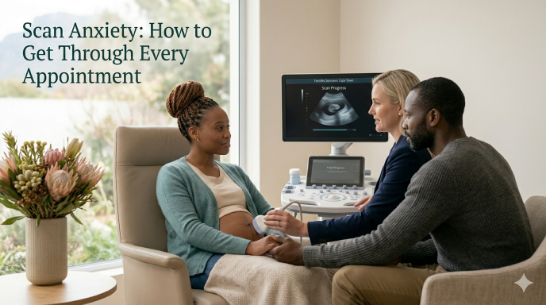
There is a specific kind of dread that arrives the night before a scan.
Not general anxiety. Not vague worry. A very particular fear that sits in the chest and doesn’t move: the fear of what the screen might show. The fear of lying in a dim room and watching a sonographer’s face for the fraction of a second before they speak.
For most people who have been through fertility treatment, this experience is familiar. The two-week wait ends and the pregnancy begins — and then a new kind of waiting starts. Scan to scan. Milestone to milestone. The fear doesn’t disappear with a positive pregnancy test; for many people, it intensifies.
This guide is for you if you recognise that experience. It covers why scan anxiety happens, what to expect at each scan milestone, and practical strategies that genuinely help.
| Scan anxiety is not irrational. It is a calibrated response to genuine past experience. If you have been through infertility treatment, miscarriage, failed transfers, or repeated bad news at appointments, your body and mind have learned to protect you from hope. That protection doesn’t switch off because circumstances have changed. |
Why Scan Anxiety Is Different After Fertility Treatment
For most people who conceive without difficulty, pregnancy scans are exciting milestones. For those who have been through infertility treatment, failed cycles, or pregnancy loss, the scan experience is fundamentally different.
Research in reproductive psychology describes what’s happening as conditioned hypervigilance — a learned state of heightened alertness to medical information, developed through repeated experiences where medical information carried genuinely bad news. The brain is doing exactly what it learned to do. Unfortunately, it’s applying a past-appropriate response to a present situation that may not warrant it.
Understanding this does not make the anxiety disappear. But it can help you be slightly less hard on yourself for having it.
The Scan Timeline — What Each Appointment Typically Involves
The 6–7 Week Scan (First Heartbeat)
This is typically the first scan after a positive pregnancy test following IVF or IUI. It’s done transvaginally and looks for:
- A gestational sac in the uterus (confirming intrauterine pregnancy, ruling out ectopic)
- A fetal pole (early embryonic tissue)
- A heartbeat — typically visible from approximately 6 weeks and 3 days
This is often the most anxiety-laden scan of the pregnancy. Many people describe it as more frightening than the egg retrieval or embryo transfer, because the stakes of the result feel so immediate. Strategies for this scan specifically are in the section below.
The 8–10 Week Scan (Reassurance)
Not all clinics or programmes offer this scan routinely, but many fertility clinics provide it as a reassurance measure before discharging patients to standard obstetric care. It confirms cardiac activity, fetal growth, and appropriate development.
The 12-Week Nuchal Scan
The 12-week scan is the first major milestone in standard obstetric care. It includes a NT (nuchal translucency) measurement — an assessment of Down syndrome and other chromosomal risk — alongside confirmation of fetal growth and anatomy. For many people, clearing the 12-week scan represents a psychological turning point — the first moment they allow themselves to feel the pregnancy might actually continue.
The 20-Week Anatomy Scan
The anatomy scan is a detailed assessment of fetal development — checking all major organ systems, confirming placental position, and measuring fetal growth. For most people, this is the scan where anxiety either significantly reduces (with normal findings) or escalates (if any finding requires further investigation). The result of this scan is typically when many people first allow themselves to begin preparing in practical ways for the baby’s arrival.
Third Trimester Growth Scans
Growth scans in the third trimester are routine or prompted by specific concerns. For many people who have been through infertility treatment, these scans — though later and with less clinical urgency than the early milestones — can still carry anxiety. The closer to birth, the more real the possibility feels — and for some, this intensifies rather than reduces vigilance.
Practical Strategies for Managing Scan Anxiety
1. Do the pre-scan preparation the day before, not the morning of
Many people find the morning of a scan consumed by anxiety that builds from the moment they wake up. If there are practical things to do (checking the appointment time, arranging transport, knowing what to wear), do them the night before. The morning of the scan should be as routine as possible.
2. Decide in advance what you’ll do immediately after
Having a plan for the hour after the scan — positive or negative — gives the experience a container. If it goes well: where will you go? Who will you tell? If it doesn’t go well: who needs to know, who will be with you, where is safe to go? Having these decisions made in advance means you are not making them in the acute aftermath of the result.
3. Bring someone with you if possible
Attending scans alone is significantly harder. If your partner cannot attend, consider asking a close friend or family member. Having a witness — someone who heard the same words, saw the same screen — matters.
4. Tell the sonographer you have fertility treatment history
Most sonographers are experienced in working with patients who have anxiety about scans — particularly those with fertility treatment backgrounds. Telling them upfront: “I’ve been through IVF and I’m very anxious” changes the dynamic. Most will narrate the scan as they go, show you the screen early, and tell you what they’re seeing before you have to ask.
5. Acknowledge the anxiety rather than fighting it
The impulse to “stay calm” and suppress the anxiety before a scan is understandable but often counterproductive. Attempts at suppression tend to amplify the feelings being suppressed. Acknowledging the anxiety — naming it, sitting with it rather than fighting it — tends to reduce its intensity more effectively.
6. Limit information-seeking in the 48 hours before a scan
The internet offers an infinite supply of scan outcomes, statistics, and forum discussions that can fuel pre-scan anxiety. Setting a defined limit on online searching in the 48 hours before a scan — not a ban, but a limit — tends to reduce anxiety amplification.
7. Reduce the gap between scans where clinically appropriate
For some patients, the standard scan schedule is not enough for anxiety management. It is entirely reasonable to discuss with your obstetrician whether additional reassurance scans are possible — particularly in the early weeks. Not all providers will offer this as standard, but the request is legitimate.
8. Consider psychological support specifically
If scan anxiety is significantly affecting your daily life — disrupting sleep, work, or relationships in the weeks leading up to each appointment — brief cognitive behavioural therapy (CBT) with a psychologist who specialises in perinatal anxiety is genuinely effective. This is distinct from general therapy and targets the specific mechanisms of anticipatory anxiety. A fertility concierge can help connect you with the right specialist in South Africa.
When the News Is Not Good
Everything above assumes the scan shows normal findings. Sometimes it doesn’t. If you receive difficult news at a scan — a missed miscarriage, a finding that requires further investigation, a heartbeat that isn’t there — please know that support is available. Our guide to pregnancy loss after IVF covers this experience in more detail. And if a cycle fails rather than a pregnancy, our guide to grief after a failed cycle addresses the specific dimensions of that loss.
People Also Ask
Q: Is scan anxiety normal after IVF?
A: Extremely normal, and expected. Research consistently shows elevated anxiety in pregnancy after fertility treatment — scan anxiety is one of its most common manifestations. It reflects a history of genuine uncertainty and loss, not an irrational response.
Q: How do I stop being anxious before a scan?
A: Rather than attempting to eliminate anxiety, most psychologists advise acknowledging and accepting it — the anxiety is a normal response to past experience. Practical strategies: do preparation the day before, bring someone with you, tell the sonographer about your history, and limit information-seeking in the 48 hours before the appointment.
Q: What if there’s no heartbeat at the 6-week scan?
A: A heartbeat is not always visible at exactly 6 weeks — it typically becomes visible from approximately 6 weeks and 3 days, and is reliably present by 7 weeks. If no heartbeat is found at a very early scan, most clinics will repeat the scan 1–2 weeks later before drawing conclusions, unless there are other clinical reasons for concern.
Q: When does scan anxiety reduce during pregnancy after IVF?
A: For most people, anxiety reduces significantly after the 12-week scan and again after the 20-week anatomy scan. For some, it persists throughout pregnancy. If it significantly affects your quality of life, please seek support from a perinatal psychologist.
Practical Takeaways
- Scan anxiety after fertility treatment is a normal, conditioned response to a history of genuine medical uncertainty — not a sign that something is wrong
- Telling the sonographer about your fertility treatment history upfront changes how the scan is conducted
- Having a plan for after the scan — both positive and difficult outcomes — gives the experience a container
- Brief CBT with a perinatal psychologist is genuinely effective for scan anxiety that significantly affects daily life
- Connect with your full pregnancy-after-infertility experience through our guide: Pregnant After Infertility: Why It Doesn’t Always Feel the Way You Expected
Disclaimer: This article is for educational purposes only and does not constitute psychological or medical advice. If scan anxiety is significantly affecting your quality of life, please seek support from a qualified perinatal mental health professional.
About the Author
Leigh-Ann Geydien is the founder of Fertility Solutions, South Africa’s only dedicated fertility directory. With a deep commitment to patient advocacy, she built the platform to bridge the gap between those navigating fertility challenges and the clinics and reproductive health specialists best placed to help them.